
Am I in a situationship?
Am I in a situationship? The question is about naming, not about behaviour. A situationship is a romantic connection that is ongoing and repeats, but that neither person has named out loud. Dictionary.com defines it as “a romantic or sexual relationship that its participants have not defined, and which can also lack commitment or exclusivity”, labels it informal, and dates the word’s first recorded use to 2005–10. If that sentence describes your arrangement, you already have your answer.
In brief: this page settles the question with one test — has the status been asked and answered out loud — and separates the real signs of an undefined arrangement from the ones that only look like it.
What is the one question that settles it?
One question settles it: has either of you asked what this is, out loud, and what did the other person say? That question sorts every case into three outcomes. You asked and got a label, whether “we’re together” or “this is casual” — defined either way, because both people now hold the same word. You asked and got an answer that moved away from the subject: “I don’t want to put labels on it”, “I like where this is going”, “why do we need to define it”. Or you never asked. The second and third outcomes are what people mean by a situationship. If you want the wording for asking, that belongs to turning a situationship into a relationship.
An answer that avoids the subject is still an answer. It tells you the other person is not ready to attach a word to this, today, in this conversation. That is information about the arrangement. It is not information about your worth, and reading it as a verdict on you makes this question harder than it needs to be.
What are the signs of a situationship?
Each of these describes a mechanic, not a fault. Any one of them can be innocent. Several at once describe an arrangement that has not been defined.
- No status word has been used by either of you. Not “girlfriend”, not “boyfriend”, not “partner”, not “we’re seeing each other exclusively”. Silence in both directions, not just theirs.
- Plans live inside a short horizon. For example, this weekend gets arranged while a wedding three months out does not. The arrangement has no assumed future, so nothing is booked into one.
- You have no place in the rest of their life. Friends, siblings, colleagues and roommates either have not met you or have met you without being told what you are.
- Contact responds rather than arranges. Messages answer messages. Very little of it initiates something new, and plans tend to form late.
- Exclusivity is assumed on one side and stated on neither. You have not seen anyone else and have not asked whether they have. That gap is the arrangement’s defining feature.
- There is no public register of it. No mention anywhere anyone else can see. The soft launch page covers what partial visibility can signal.
Which combination you have changes what happens next, because undefined arrangements are not all the same shape — see the types of situationships.
What is not a sign?
A slow pace is not a sign. Two people can be moving deliberately towards something defined and simply not be there yet. A busy stretch is not a sign either, such as a deadline, a sick parent or a double shift, which can explain a thin stretch of contact without saying anything about status. Not having met their family is not a sign on its own. Not posting about you is not a sign on its own either, because people in named relationships post about nothing too.
The talking stage is a phase with movement in it — you are still finding out whether there is anything here — and on its own it is not a situationship. It becomes an undefined arrangement when the finding-out has finished, the seeing-each-other has settled, and the naming never happened. See the talking stage versus a situationship for the fuller split.
One more thing that is not a sign: wanting a label. Wanting one says nothing about which state you are in. 26% of US adults who are not in a committed relationship say they are looking for either a committed relationship or casual dates (Pew Research Center, 2020). Arriving open to both is an ordinary way to arrive, and it is not a defect on anyone’s part. See the source.

Am I in a situationship or a relationship?
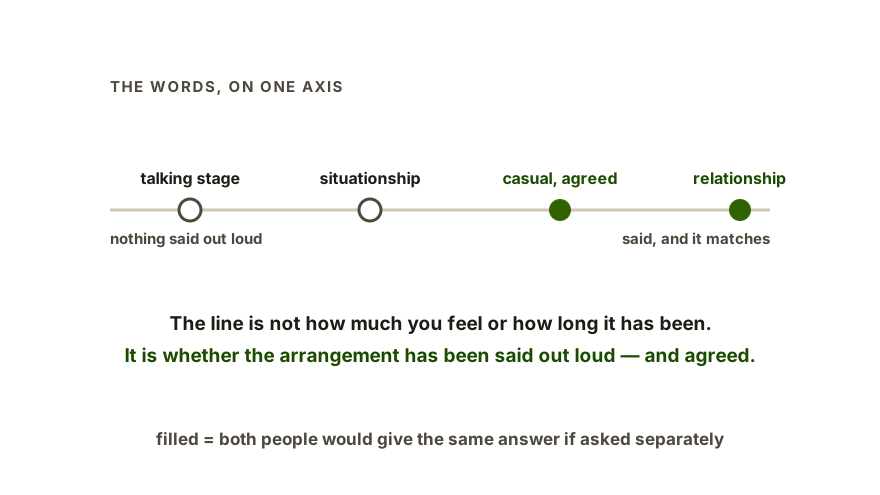
A relationship is an arrangement both people would describe with the same word to a third person. A situationship is the same behaviour without that agreement. Nothing else separates them reliably: not how often you see each other, not how much you like each other, not how long it has run, not knowing each other’s coffee order. Two people can spend a year together weekly and still hold two different private definitions of what it is. The full split, axis by axis, is on situationship vs relationship.
| State | Has a status word been said? | What that means |
|---|---|---|
| Talking stage | Not yet — still finding out | Too early to test; nothing has settled either way |
| Situationship | No — asked or never asked, no label given | Ongoing and romantic, but undefined |
| Relationship | Yes — both people use the same word | Defined; the label was said out loud and agreed |
Is a situationship bad?
A situationship is neutral as a category. It becomes costly through mismatch: one person treating the arrangement as a route to something named, the other treating it as the destination, and neither saying so. The cost is not in the absence of a label. It is in two people running on definitions they have never compared.
It is also common enough that being in one says nothing unusual about you. 39% of US adults say they have ever been in a situationship (YouGov, 2024). Half of Americans aged 18 to 34 (50%) say they have ever been in one (YouGov, 2024). Both figures describe having been in one at some point, not being in one right now. Both numbers, with the method.
The strongest word people reach for here can be doing the work of a different sentence: this hurts and I do not know why. Naming the mechanic explains more than naming the other person. The hurt can come from the mismatch, the horizon that never extends, or the ambiguity itself, rather than from a defect in the person you are seeing.
When does it stop being a dating question?
There is a point where the state of the arrangement stops being the thing that matters. The markers are practical, not diagnostic: you are checking your phone in a way that interrupts work, your week is being arranged around when someone might be free, or you are not sleeping. Or the thinking about it has become constant and does not stop when you decide to stop.
That is where this article’s job ends. A page about vocabulary cannot tell you what is happening in your own head, and it should not try. If a connection is affecting your sleep, your work or how you function day to day, that is worth taking to a doctor or a licensed therapist. A real one, in a room or on a call, not an article — nothing here is a diagnosis and nothing here is treatment.

What can you do once you have named it?
Naming the state is not the same as deciding about it. Once you know you are in an undefined arrangement, three decisions exist, and all three are legitimate. You can ask the direct question and find out what the other person is willing to name. You can set your own limits and stay, deciding what you will and will not do inside an arrangement that carries no promises. Or you can end it, which is a real ending even though nothing was ever officially started.
None of the three is the mature choice or the weak one. They are three different answers to the same fact. The rest of this site covers each of them in turn, starting from what a situationship is.