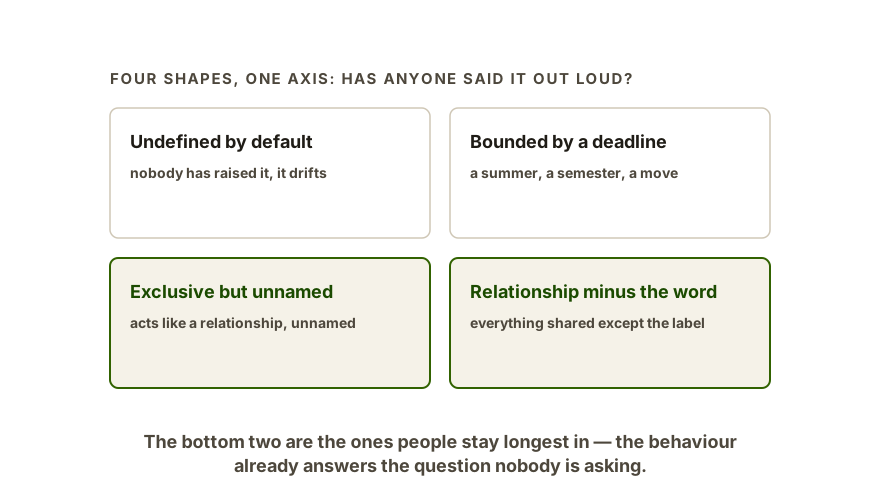
Types of situationships are not personality categories and they are not a ranking. They are shapes an undefined arrangement takes, and each shape is set by two plain facts: whether anyone named the thing out loud, and whether an ending is already built into it. Naming which shape you are in does not settle what to do — it does narrow the list of decisions that exist.
What are the types of situationships?
Four shapes recur in how people describe situationships. The first is undefined by default: nobody raised the question, so no answer exists. The second has a deadline in it — a summer, a semester, a posting abroad. The third is exclusive in practice but has no name. The fourth behaves like a relationship in every respect except that neither person uses the word.
In brief: the four shapes below sort by one test — has anyone named the arrangement, and does it already carry a built-in end date — and that test, not the feeling inside it, decides what to do next.
Dictionary.com defines a situationship as “a romantic or sexual relationship that its participants have not defined, and which can also lack commitment or exclusivity”, labels it informal, and dates the word’s first recorded use to 2005–10. That “can also” is what makes a taxonomy necessary: the definition leaves exclusivity, duration and intent open, so the shapes underneath it differ sharply from one another.
| Type | What marks it | What is actually undecided |
|---|---|---|
| Undefined by default | Nobody has raised the question | Everything — including whether either person wants more |
| Deadline-bound (summer, long distance, temporary posting) | An end date exists in the calendar, not in the conversation | Whether it is meant to survive the end date |
| Exclusive but unnamed | Neither of you is seeing anyone else | Whether the exclusivity is agreed or assumed |
| Relationship without the word | It functions as a relationship in daily life | Why the word is being avoided, and by whom |
What is the undefined-by-default situationship?
The undefined-by-default situationship is the shape that forms without anyone choosing it. Two people see each other, the frequency rises, and the question of what this is never gets asked — not out of strategy, but because there is no obvious moment to ask it. Nothing was agreed, so nothing was broken. It is the version people mean when they say they “fell into” something.
It is also a widely shared experience. YouGov’s 2024 survey found that 39% of US adults (YouGov, 2024) say they have ever been in a situationship, using a question that defined one as a romantic connection in a gray area, neither strictly platonic nor officially a committed relationship. In the same YouGov survey, half of Americans aged 18 to 34 (50%) (YouGov, 2024) said they had ever been in one. Both figures are lifetime experience, not a snapshot of who is in one now, and we keep them on our statistics page with their full wording.
Part of why the undefined shape forms so easily is that people arrive at the same meeting point with different aims. Pew Research Center reported in 2023 that 44% of US adults (Pew Research Center, 2023) who had used a dating site or app in the past year said meeting a long-term partner was a major reason they used them. Separately, 40% of that same past-year group (Pew Research Center, 2023) said dating casually was a major reason. Respondents could name more than one major reason, so those groups overlap rather than compete — but two people can start from either answer and never compare notes.
What is a summer situationship?
A summer situationship is one with the ending pre-installed. The season, the internship, the sublet or the semester supplies an end date, and both people can see it from the beginning. That changes the mechanics: the usual pressure to define things is absorbed by the calendar, because “what are we” feels answerable with “we’re here until the sublet ends”.
The specific difficulty of this shape arrives late. The deadline resolves the status question right up until the deadline stops being hypothetical, at which point one person may be deciding whether to ask for a version that continues, while the other has been treating the end date as settled. Nothing was hidden. The two of you were simply answering different questions the whole time.

Can a long-distance relationship be a situationship?
Yes — distance describes logistics, not status. A long distance situationship is one where the undefined part and the geography are separate facts that get confused for each other. People read the difficulty of visiting as an explanation for the vagueness, when the vagueness would be there at ten minutes’ walk — imagine the same undefined pause between two people who live on the same street.
What distance does change is the supply of ordinary moments in which a definition would surface by itself: no running into their friends, no default weekend, no accumulating small evidence of where you stand. The relationship exists mostly in messages, which are easy to keep warm and hard to read intent from. So it can stay unnamed without anyone avoiding anything, and a direct question does more of the work here.
What is an exclusive situationship?
An exclusive situationship is one where neither person is seeing anyone else, but no one has said the word — the exact variability Dictionary.com flags when it notes a situationship “can also lack commitment or exclusivity.” From the inside it can feel indistinguishable from a relationship, because the behaviour matches. The undecided part is not the exclusivity — it is whether that exclusivity was agreed or assumed, and those two states behave completely differently under pressure.
Agreed exclusivity has a sentence behind it that both people remember. Assumed exclusivity is an inference from evidence: they are always free, they reply quickly, you have not heard about anyone else. The inference may well be correct. It is still an inference, and it carries no obligation on the other person, which is why this shape can produce a sharp surprise when someone turns out to have read the situation differently.
What does it mean when it’s a relationship without the word?
A relationship without the word is the shape where everything a relationship contains is present — routine, planning, each other’s friends, holidays, difficult conversations — and the label is the only missing piece. The pattern is worth naming because the usual advice about “what you’re getting” does not apply: you are getting most of it. What is absent is the declaration.
The word is being withheld for a reason, and the reason can be specific rather than sinister. Consider a recent divorce, a family that would react, an earlier promise to stay single for a while, a job move that has not been decided, or simply a strong dislike of announcing things. None of that is readable from the outside. If the label matters to you, the only way to learn which reason applies is to ask, and to listen to whether the answer names a condition that could change. How to ask, and what an evasive answer means is a separate piece.

What are some examples of situationships?
Described as patterns rather than as people, the recurring situationship examples look like this — for example, two people who met on an app, see each other regularly, and have never used a word for it. Two colleagues who spend evenings together and behave as strangers at work. Someone in a different city who calls at night and visits when they can. A pair who agreed to keep it casual and have not revisited the agreement since.
Each of those maps onto one of the four types of situationships above, and none of them tells you anything about the character of the people in it. The pattern is a description of an arrangement, not a diagnosis of the person you are seeing.
How does the type you’re in change what to do next?
The type narrows which decisions are real. In the undefined-by-default shape, the missing element is information, so the next move is a direct question rather than a change in behaviour. In the deadline shape, the useful conversation is about what happens after the end date, and it is worth having before that date is close enough to be emotional.
In the exclusive-but-unnamed shape, the gap is between agreement and assumption, so the sentence to say out loud is the one that converts an inference into a stated understanding. In the relationship-without-the-word shape, the question is not what you are doing but why the word is absent — and whether the reason has an expiry.
If you are still deciding which shape describes yours, the signs, described plainly works through it question by question. If the answer you reach is that you want out, ending it out loud covers saying so. The situationship hub holds the definition and the rest of the decisions.
One limit on this page: it describes arrangements, not states of mind. If the uncertainty has turned into anxiety or preoccupation that is affecting your sleep, work or health, that is outside what an article about categories can help with, and a doctor or a therapist is the right place to take it.