
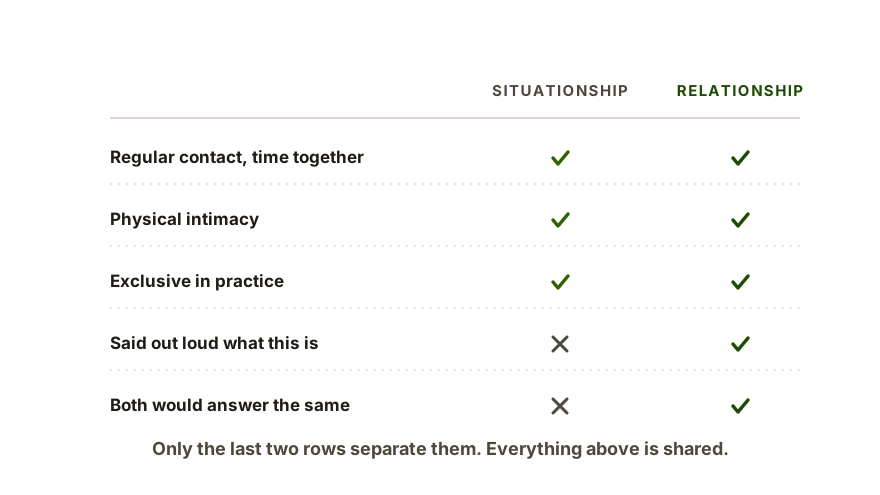
Situationship vs relationship is not a question about feeling, effort or time served. The gap between the two words is one specific thing: whether you have said out loud what this is, and whether the two of you would give the same answer if asked separately today.
What is the difference between a situationship and a relationship?
Defined versus undefined is the whole of it. Two people in a relationship have said the word out loud, agree on which word it is, and would each repeat it to a friend without hedging. In a situationship the romantic behaviour is present and the definition is absent: nobody has named the thing, exclusivity has no stated answer, and no shared plan reaches past the near term.
In brief: the two words split on one test — has it been said out loud and agreed — and everything else people use to tell them apart, including time and intimacy, turns out to be a proxy for that one missing sentence.
Dictionary.com defines a situationship as “a romantic or sexual relationship that its participants have not defined, and which can also lack commitment or exclusivity”, labels the word informal, and dates its first recorded use to 2005–10. Notice that the dictionary carries the same test: have not defined. Everything else on this page is an elaboration of that one clause.
Where does the line between a situationship and a relationship fall?
Four axes carry the difference between a situationship and a relationship. None of them is about how much the two people like each other, and none of them is about how long it has been going on.
Exclusivity: is there an answer, or an assumption?
In a relationship, exclusivity has an answer — including “we are not exclusive”, which is still an answer, because both people know it. In a situationship, exclusivity is unstated, which means each person is running on a private assumption and neither knows what the other one’s assumption is. The asymmetry is the defining feature, not the exclusivity itself.
Intentions: are they named or left open?
A relationship involves stated intentions: each person has told the other what they want this to be. A situationship keeps intentions in the “seeing where it goes” register. That phrase can be honest — not knowing yet is a real state — but while it is in use, nothing has been settled, and the connection stays undefined by default.
Publicness: how are you introduced?
A relationship comes with a title that can be used in front of other people: someone is introduced as a partner, a girlfriend, a boyfriend. In a situationship there is no agreed title to use, so introductions route around it — for example, a first name, “my friend”, or nothing at all. Publicness is a proxy signal rather than proof, but it is a proxy for exactly the thing in question: whether a word has been agreed on.
The future: whose plans assume the other person?
A relationship generates plans that take the other person as given: a trip in October, a wedding invite, a lease. In a situationship there is nothing settled for plans like that to rest on: plans that assume someone will still be there are hard to make when neither of you has said whether you will be.
| Axis | Situationship | Relationship |
|---|---|---|
| The label | Not agreed out loud, or deliberately left open | Agreed out loud; both people use the same word |
| Exclusivity | Not stated; each person may assume differently | Has a stated answer, and both know it |
| Stated intentions | Kept open — 'seeing where it goes' | Named: what each person wants this to become |
| Publicness | Introduced without a title, or not introduced | Introduced with a title other people recognise |
| The future | No agreed status for longer-term plans to rest on | Plans made on the assumption both are still there |
| How it can end | Can fade out with no conversation marking it, since there is no status to end | Ending is itself a stated act, because there is a status to end |
Read the table as a description of two states, not a scoreboard. A defined relationship is not automatically the better outcome for a given person at a given time, and an undefined connection is not automatically a failure of one. What the table does is let you locate yourself: if your row-by-row answers land mostly in the left column, the word for it is situationship, and knowing that is the point.
Is a situationship just casual dating with a newer word?
No, and this is the mix-up worth spelling out. Casual dating is a defined arrangement: both people know it is casual, and both would say so if asked — consider two people who agree up front that neither one is looking for more. A situationship is undefined, which is a different thing entirely — it leaves room for two people to hold incompatible assumptions without either one lying.
The two are also measured differently, where they are measured at all. Pew Research Center found in 2020 that 13% of US adults (Pew Research Center, 2020) who are not married, not living with a partner and not in a committed relationship said they were currently casually dating someone. That figure counts a named arrangement. It is not a count of situationships, and nobody should treat it as one.
For the newer word, the closest thing to a prevalence figure comes from YouGov, which found in 2024 that 39% of US adults (YouGov, 2024) said they had ever been in a situationship. Ever, not currently: the survey asked about lifetime experience of “a romantic connection that exists in a gray area, neither strictly platonic nor officially a committed relationship”. Between them, those two numbers show that the gray area and casual dating are not the same object, and are not counted the same way.
Why do the labels matter at all?
A label matters because it is the only thing that makes two people’s expectations checkable against each other. Without one, you are each modelling the other’s intentions from behaviour, and behaviour is a poor instrument, because the same weekend can read as building something to one person and as pleasant and temporary to the other.
There is also evidence that people arrive at the same connection wanting different things, without either being dishonest. Among US adults who had used a dating site or app in the past year — 9% of adults (Pew Research Center, 2023) on Pew Research Center’s 2023 figures — 44% said meeting a long-term partner was a major reason (Pew Research Center, 2023) they used them. And 40% said dating casually was a major reason (Pew Research Center, 2023). Respondents could pick more than one reason, so those are not two opposing camps; they are evidence that both motives are ordinary and travel in the same crowd.
Pew Research Center also found, in its 2020 report, that 26% of US adults (Pew Research Center, 2020) who are not in a committed relationship said they were looking for either a committed relationship or casual dates. That is the closest measured description of arriving without a fixed label — not a fault, and not a category of person, just a common starting position. Which is exactly why the word eventually has to be said out loud by somebody: openness is a starting state, not a shared definition.

How do you find out whether you’re in a situationship or a relationship?
You ask, in one sentence, and you listen to the answer rather than to the tone. Something like “I want to know what we’re doing here — are we seeing other people?” does the work. It is not an ultimatum, it does not require a script, and it does not need to be scheduled.
Three kinds of answer come back. A definition (“we’re exclusive”, “we’re not exclusive”) settles it either way. A counter-question that ends in a shared decision also settles it. An answer that acknowledges the question and gives no position — “let’s not put labels on it”, “why does it have to be a thing” — is itself information: it tells you the state is undefined and that the other person is, for now, choosing to keep it that way.
That last case is worth naming carefully. An evasive answer is not proof of anything about the other person’s character. It is proof about the state of the connection, which is the only thing you needed to establish. If you want the longer version of the conversation, how to turn a situationship into a relationship walks through asking without a script. If you want to work from signs instead, am I in a situationship? sets them out one at a time.

What if it isn’t a relationship and isn’t a situationship either?
Two neighbouring states get mistaken for both. The talking stage is a phase with an implied direction — people in it are working out whether to date — while a situationship is a state that can sit still indefinitely. And with friends with benefits the difference is one of expectation rather than behaviour: an FWB arrangement can be defined, just defined as something other than romance.
If none of the four fits, the general definition on the situationship hub is the place to start, and the statistics page lists every figure this site will print, with its publisher, year and the constraint on how it may be used.
When does naming the state stop being the useful move?
Naming the state is a description, not a resolution, and it is worth being honest about where that stops helping. If the uncertainty has become the main thing in your week — sleep going, concentration going, the same loop of thoughts every evening — that is no longer a question about vocabulary. No article, including this one, is the right instrument for it — a therapist or your doctor is. Naming the state can make the conversation with them easier; it cannot substitute for it.
For everything short of that, the honest summary is short. A relationship is the version where somebody said the words. A situationship is the version where nobody has yet. Whether saying them is what you want is a separate question, and it stays yours.