
How do you end a situationship?
How to end a situationship is a narrower problem than how to end a relationship, and a stranger one. Ending a situationship means stating the stop out loud, since nothing about an undefined arrangement ends on its own — it ends because someone says it has. There is no label to remove and no agreement to break, so silence just reads as a quiet week rather than an ending. Dictionary.com defines a situationship as an arrangement its participants “have not defined” — which is exactly why an ending needs a voice attached to it rather than a default. 87% of US adults say breaking up in person with someone you are casually dating is always acceptable (Pew Research Center, 2020), which is the baseline this page works from. Everything below is wording and timing around that single stated act.
In brief: this page settles what to actually say, when text is a reasonable channel and when it is not, and what to do if you still care about the person you are ending things with.
Why does ending a situationship need to be said out loud?
Because an arrangement that was never named cannot be un-named. In a defined relationship, the label does part of the work: removing it is a recognised event with a recognised word. In an undefined one, there is nothing to remove, so silence reads as an ordinary quiet week rather than an ending. Both people can be left unsure whether the thing is over.
A stated ending is a fact with a date on it, not an ambiguous quiet week either of you can reinterpret later. That matters for you, because an unstated ending is one you can reverse at 1am, and it matters for them, because they otherwise have to guess. If you want the mechanics of the state you are ending, that is what a situationship is and how to tell whether you are in one.
There is a second reason, and it is practical rather than moral. An unmarked ending keeps the door open for the contact that comes later — the message that starts again as if nothing happened. A stated ending does not prevent that message, but it removes any confusion about what it is.
How do I know when it is time to end a situationship?
Decide by what has already happened in the situationship, not by how the week has felt. Three situations are decisive on their own. You asked what this is and got an answer that moved away from the question. You have named something you need — exclusivity, plans, a title — and it has not changed since. Or you now know you want a defined relationship and this person has said, in words, that they do not.
You also do not need an incident. “This is not what I want” is a complete reason, and the absence of a betrayal does not make an ending premature. It is tempting to wait for the other person to do something bad enough to justify leaving, which is a long wait in an arrangement whose defining feature is that nobody promised anything.
If the honest answer is that you would stay if it were defined, the decision on this page is not the one you are facing. That one is turning it into a relationship, and it is a different conversation with a different opening line.
What do you actually say to end a situationship?
Say that you are stopping, give one true reason if you want to, and stop there. For instance, “I’ve decided to stop seeing you” says the whole job in five words; the versions below just add context for harder cases. No case, no evidence, no invitation to respond point by point.
- The plain version. “I’ve decided to stop seeing you. I’m not looking to talk it through — I just didn’t want to disappear on you.”
- When you want something they have said they don’t. “I want a relationship, and you’ve been clear that you don’t. That’s fine, but it means I need to stop this.”
- When the reason is the ambiguity itself. “I can’t keep doing something we haven’t defined. I’m ending it rather than asking you to define it.”
- When there is no reason beyond fit. “This isn’t what I want, and I’d rather say that than slowly answer less.”
- When you care about them. “I’ve liked this a lot. I’m still ending it, because it isn’t going where I want to go.”
Three things weaken any of these. Asking a question at the end reopens the decision. Listing grievances turns an ending into a debate you can lose. And “maybe in the future” leaves the door open on purpose, which is worth doing only if you mean it.
Expect one of a few responses: acceptance, surprise, an offer of the thing you asked for earlier, or nothing at all. A late offer is not automatically insincere, and it is also not something you have to answer that evening.

Is ending a situationship over text okay?
Often, yes — though the norms people state when asked are stricter than the channel question feels in the moment. 87% of US adults say it is always acceptable to break up in person with someone you are casually dating (Pew Research Center, 2020; full question and base). Text is more divisive. In the same Pew survey, 48% said breaking up by text message with someone you are casually dating is never acceptable (Pew Research Center, 2020; full question and base). Another 18% said it is sometimes acceptable (Pew Research Center, 2020; full question and base). Those are judgements about what is acceptable, not records of what anyone did.
Read together, they say something useful: in-person is the option nobody objects to, and text is contested rather than settled. Consider that a situationship is by definition undefined, so neither of you can appeal to an agreed standard — the channel choice is yours to make on the facts of the thing.
| Channel | Fits when | Costs |
|---|---|---|
| In person | It ran a long time, you share friends, or you have met each other's people | Hardest to do; invites a live negotiation you may not want |
| Phone or video call | It was long-distance, or in-person feels disproportionate but text feels thin | Timing is awkward to arrange; no record of what was said |
| Text or DM | It was short, mostly remote, or the contact already lived in messages | Reads as dismissive to some people; easy to over-explain |
| Saying nothing at all | Never, if there was repeated contact; safety is the exception | Leaves the ending unmarked and the question open indefinitely |
One exception overrides the table. If you feel unsafe, if there has been pressure or intimidation, or if the person has not accepted a stated limit before, you owe no conversation and no channel choice. Blocking without explanation is a legitimate ending, and priority goes to your safety over anyone’s sense of what is polite.

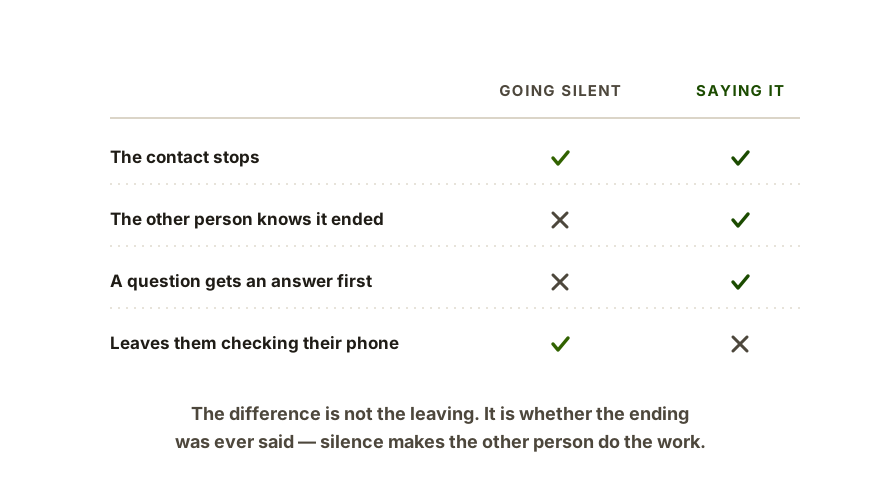
Is ending a situationship silently the same as ghosting?
Not quite, and the difference is repetition. Ghosting is Dictionary.com’s “practice of suddenly ending all contact with a person without explanation” — here, inside an ongoing connection rather than after one date. Declining to reply after a single first date is a thinner thing, and even the research treats it separately. 52% of single US adults on the dating market said that after a first date they did not want to repeat, they would not contact the person but would answer if contacted (Pew Research Center, 2020; full question and base). In the same Pew survey, 40% said they would contact the person to let them know (Pew Research Center, 2020; full question and base). Both figures are hypothetical intentions about a first date, not about ending something that has been running for a while.
The gap between those two answers is where the awkwardness of this whole subject lives. A fade is the easier move, a stated ending is the one those survey answers favour, and a situationship sits between the first date those figures describe and a relationship they do not. For what the word covers and what it does to the person on the other end, see ghosting.
What if you still love the person you are ending the situationship with?
Say the feeling out loud and end the situationship anyway. Affection is not an argument against ending an arrangement — it is what makes ending it hard, which is a different thing. The sentence that does the most work here holds both halves without softening either: I like you, and this is not what I want.
Two habits make this ending harder than it needs to be. One is bargaining with yourself about whether the feeling proves the arrangement should continue; it does not, because feeling and format are separate questions. The other is ending it in a way designed to make them object. If part of you wants the message to produce a counter-offer, you are not ending it, you are asking the direct question in a costume — and that question deserves to be asked plainly instead.
None of this is about making someone realise what they lost. An ending written to produce that reaction treats the other person as a mechanism to operate rather than an adult who gets to have their own answer, and it keeps the decision in their hands rather than yours.
How do guys feel when you end a situationship?
Nobody has measured how men — or anyone — react when a situationship ends, so there is no honest percentage to give. What is observable is that the reaction arrives in a shape rather than a size: quick agreement, a delayed reply, an argument about the framing, or silence followed by contact later on. None of those reveals how much the arrangement meant, and reading them as a verdict on you is the fastest way to reopen something you decided to close.
The late message deserves its own note. Contact that returns after an ending is about their week, not about a revised assessment of you. It is not evidence of regret, and it is not evidence of indifference either. You get to answer it, or not, on the same terms you used to end things.
What happens after you end a situationship?
The ending is one act; what follows an ended situationship is a separate problem with its own mechanics — including grief for something that never had a status, which is real grief and does not require anyone’s permission. That is covered in getting over a situationship, including the part where no closure conversation is ever going to happen.
Practically, the period straight afterwards goes better with two decisions made in advance rather than at 1am: what you will do about their social media, and what you will do if they message. Neither needs to be permanent. Both need to be decided while you are not being asked.
There is a limit to what a page like this can do. If the ending has left you unable to sleep, work or think about anything else, that belongs with a doctor or a licensed therapist rather than an article. The same is true if the thinking has become constant and does not stop when you decide to stop it. Nothing here is a diagnosis and nothing here is treatment. Every figure quoted above is listed with its source and method on the statistics page.