
What does benching mean in dating?
Benching in dating means keeping someone in reserve. Contact continues at a level low enough to cost nothing and high enough to stop the person drifting away: a message every few days, a warm reply, an occasional “we should do something soon” that never becomes a date. Dictionary.com's dating-slang glossary defines benching as “keeping a potential romantic partner on hold in case others don’t work out.”
In brief: benching is contact that continues without ever turning into a plan, and the only reliable way to tell it apart from a busy person is what happens when a specific date gets proposed.
The word names a pattern, not a confession. Someone benching you has not necessarily decided to bench you. The behaviour is what an unresolved preference looks like from the outside when nobody says anything out loud.
Where does the word come from?
It is borrowed from team sport. A benched player is on the roster, in kit, watching from the sideline, available if someone ahead of them comes off. The metaphor carries the two things that make the dating sense sting: you are still on the team, and you are not being played.
The dating sense lives in slang rather than in a dictionary. Dictionary.com’s dating-slang glossary, published in November 2021, carries the definition quoted above, but that is an editorial article; the dictionary’s own entry for benching has no dating sense. Anyone telling you benching “is in the dictionary” is describing a glossary.
Compare that with older vocabulary. As of its October 2019 fieldwork, 62% of US adults said they had heard of the dating term “ghosting” (Pew Research Center, 2020) — awareness of the word, not experience of the behaviour. There is no equivalent measurement for “benching” that this site can source, so this page does not guess at one. The full wording and base of that Pew figure sits on our statistics page.
What does benching actually look like?
Four things tend to be true at once, and any one of them alone means very little.
Contact is steady but shallow. Replies arrive, often quickly, often friendly. They answer what you asked and open nothing new.
Plans stay in the future tense. Consider phrases such as “we should get dinner”, “when work calms down” or “definitely next week” — enthusiasm about a meeting, no date proposed for it. If a time is set, it is set by you.
Availability is late and low-cost. The messages that suggest actually meeting arrive at short notice, on their terms, in their neighbourhood, on a night that was otherwise empty.
Attention returns when you withdraw. You go quiet for a week and a message appears. Not a plan: a message. The pattern keeps the connection alive without advancing it.
What that adds up to is a connection with a heartbeat and no direction. It is one of the ways an undefined connection sustains itself without either person lying.

Why do people bench someone?
The mechanics are ordinary, and none of them require someone to be cruel or calculating about it.
They are genuinely undecided and dislike closing doors. 26% of US adults who are not in a committed relationship say they are looking for either a committed relationship or casual dates (Pew Research Center, 2020) — the group open to both at once. That is not a measure of benching, and it is not a measure of situationships. It does describe how many arrive at dating without a fixed outcome in mind, which is the state benching grows out of. The exact base is on the statistics page.
Several conversations are running in parallel. Among US adults who had used a dating site or app in the past year, 44% say meeting a long-term partner is a major reason they used them (Pew Research Center, 2023). Another 40% say dating casually is a major reason (Pew Research Center, 2023). People could give more than one reason, so these are overlapping motives rather than two camps. Only 9% of US adults used a dating site or app in the past year (Pew Research Center, 2023), so this is a slice of the public, not the whole of dating. Where several threads run at once, the ones that are not currently first do not get ended. They get under-tended. All three figures, with their exact bases, are on the statistics page.
Ending things is a conversation nobody schedules. Saying “I’ve met someone I’m more interested in” is a short conversation that feels, in advance, like a long one. Low-effort contact is what avoiding that conversation looks like in practice.
They like you at the level the contact suggests. Sometimes the least dramatic reading is the right one: they enjoy the messages and do not want more than the messages. Nothing is being hidden; the effort level is the answer.
How is benching different from ghosting, orbiting and breadcrumbing?
All four are ways a connection can fail to end properly. They differ in what continues.
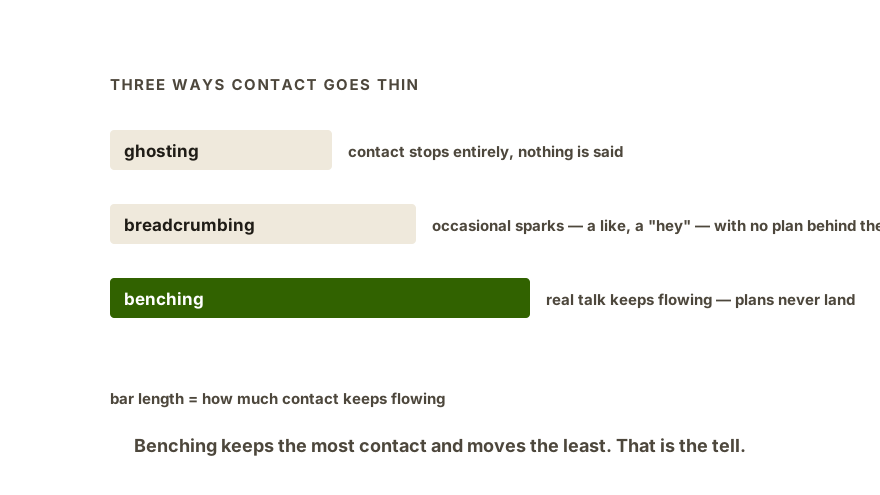
Ghosting means contact stops entirely, with no explanation given; the information is bleak but complete. See ghosting for the full page. Benching sits at the other end of that same scale: contact continues, progress does not, and you are being kept rather than dropped. Orbiting refers to contact that stops in messages while watching continues, such as when they see your stories and never write back. Dictionary.com's dating-slang glossary defines orbiting as “when someone breaks off all contact with a person they were dating in real life, but they continue following that person on social media.” Zombieing is contact that stopped some time ago and then restarts as though the gap never happened; it and haunting have their own page, zombieing, haunting and orbiting.
Breadcrumbing refers to the wider label for low-effort contact that keeps a connection warm without going anywhere. The two labels are used interchangeably in everyday speech; where they part, benching implies a reserve list and breadcrumbing implies only the crumbs. We deliberately do not cover breadcrumbing as a topic, for the reasons set out in our dating terms glossary.
The whole family shares one mechanic: presence without intent. Benching is the version where the presence is warmest, which is exactly why it is the hardest to read.
| Behaviour | Contact | Plans | What you can observe |
|---|---|---|---|
| Benching | Continues, low effort | Discussed, never set | Warm replies, no date ever arrives |
| Ghosting | Stops outright | None | Replies end; a direct question goes unanswered |
| Orbiting | Stops, watching continues | None | No replies, but your stories keep being viewed |
| Breadcrumbing | Occasional, low effort | Rarely proposed | Sparse contact keeps a connection barely alive |
How do you tell benching from someone who is just busy?
You cannot tell from the message volume, and that is the trap. Busy people and benching people send similar texts. The difference shows up in one place: what happens when a real, specific plan is put on the table.
A busy person who is interested counters — for instance, they cannot do Thursday, so they offer the Sunday after next, and then they keep it. Someone treating the connection as a reserve option does not counter. The enthusiasm stays, the specifics do not appear, and the next warm message arrives as if no date had been discussed.
Repeated declines with no alternative offered are a pattern; a single one is a busy week. This is also the point at which the difference stops being diagnosable from behaviour at all, which is what the next section is for.

What can you do if you think you’re being benched?
Ask a question that cannot be answered with warmth. Not “do you like me” — that gets a yes and changes nothing. Something with a date and a scope in it: I’ve enjoyed this, and I’d like to actually see you. Are you free either night next weekend? Or, if the ambiguity is the problem rather than the calendar: I’d rather know where you’re at with this than guess. Are you looking for something that goes somewhere?
Then read the answer as information rather than as a verdict. A specific time is an answer. “Things are mad right now, but soon, I promise” is also an answer: it declines to give a time while asking you to keep waiting. An evasive reply is not proof of bad faith; it can simply mean the decision has not been made and the person would rather not have it forced. Either way you now know what you are choosing between, which is the only thing the question was ever going to buy you.
The decision after that is yours and it is genuinely open. Some people are content to keep a low-effort connection running with the expectations adjusted downward. Others find the waiting is the part that costs them. Neither choice is the smart one in the abstract.
Can you be the one doing the benching?
You can, and it does not feel like strategy from the inside. If there is someone you reply to warmly, never make plans with, and message again whenever they go quiet, that is the pattern from the other side. It feels like not wanting to lose touch with someone you are not sure about.
The fix is small and unpleasant: either propose an actual time, or say plainly that you are not looking to take it further and let the person decide whether to keep texting. Both are short. The version where you keep the thread warm indefinitely is the one that costs someone else their time.

When does this stop being a dating question?
Being kept in reserve by someone you like is a genuinely disorienting experience, largely because the evidence is contradictory by design: warm messages, no movement. Rereading old chats for a clue is a normal response to that, and it can settle once you have asked a direct question and heard the answer.
Where this article’s job ends: if the not-knowing has turned into thinking you cannot put down, sleep you are not getting, or checking behaviour that is eating your days. That is not a vocabulary problem, and no glossary entry fixes it. A therapist or your doctor is the right address, and going is not an overreaction. Naming the pattern is useful. It is not treatment.