What is the difference between the talking stage and a situationship?
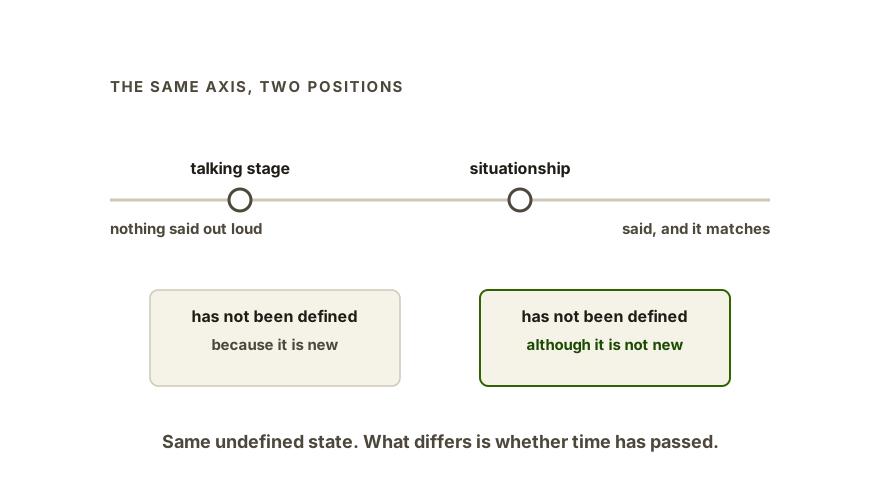
Talking stage vs situationship is a phase against a state. In the talking stage, two people are still deciding whether to date, so nothing being defined yet is the normal condition of the period. In a situationship, the deciding has stopped happening and the connection continues anyway. The messages, the dates and the tone can be the same in both.
In brief: both words describe an undefined connection. The difference is whether the question of what it is has genuinely not been asked yet, or has been asked, or avoided, and the arrangement kept going anyway.
That is why the two words often describe the same week from different distances. The talking stage is what you call it while the question is open. Situationship is what you call it once the question has been open long enough that nobody is asking it any more. Neither word is obscure: “situationship” was recognisable enough by 2023 to be named one of four finalists for Oxford University Press’s Word of the Year, alongside rizz, which won, plus Swiftie and prompt (Oxford University Press, 2023).
| Talking stage | Situationship | |
|---|---|---|
| What the word names | A phase you are passing through | A state you are sitting in |
| Is the label missing? | Yes, and that is expected this early | Yes, and it has stopped being temporary |
| Direction | Pointed at a decision | Not pointed anywhere in particular |
| Who uses it | Both people, while it is happening | Applied afterwards, sometimes by only one of them |
| Exclusivity | Still an open question | Sometimes discussed, sometimes assumed, sometimes neither |
| What resolves it | Time plus a conversation | A conversation; time alone does not |
What does “talking stage” mean?
The talking stage is the period after mutual interest is obvious and before either person calls it dating: regular texting, calls, meeting up, and no agreed word for any of it. The phrase is casual American speech rather than a formal category, and we have no dictionary definition to quote for it, so the wording above is our own. The talking stage hub covers the phase on its own terms.
The load-bearing part is the assumption inside it. Calling something the talking stage implies the arrangement is being worked out — that a direction exists even if it has not been named. Remove that assumption and the phrase stops fitting.
What does “situationship” mean?
A situationship is, in Dictionary.com’s words, “a romantic or sexual relationship that its participants have not defined, and which can also lack commitment or exclusivity” — labelled informal, with the word’s first recorded use dated to 2005–10.
Read that definition closely and the contrast does the work: it describes a relationship that has not been defined, with no clock attached. The talking stage has a clock built into the word. A situationship is what remains when the clock stops mattering.
Is the talking stage before a situationship?
In how people use the words, yes. The talking stage is the opening period; a situationship is one of the places that period can settle if nobody defines it. But this is a habit of speech, not a sequence anyone can enforce. Some connections move from talking straight into a named relationship. Some are undefined from the first message and were never a talking stage at all.
The practical version: a talking stage does not become a situationship on a particular date. It gets described differently once one person notices it has stopped moving.
Which one am I in?
Ask what happens when the subject of “what is this” comes up. In a talking stage, that question has not arrived yet, or it arrived and got a real answer. In a situationship, it has arrived and been deflected, or both people are quietly avoiding raising it. The state of that one exchange sorts the two better than any list of behaviours.
Three ordinary observations, none of which is a verdict about anyone:
- Plans. Notice whether plans stretch a little further ahead each time, or stay a constant size.
- Information. In a talking stage, both people are still finding things out about each other. In a situationship, the finding-out has largely stopped and the contact continues.
- Language. Listen for whether the other person uses future-tense words about you at all. Not as a test of feelings — just as data about how they picture the thing.
For example, plans that move from “sometime this week” to “Friday at eight” over a month are widening; plans that stay same-day and last-minute for months are not, whatever else is happening between them.
If you want the situationship-side version of this check, am I in a situationship? runs it the other way round. And if the question you actually have is about duration, how long should a talking stage last explains why no honest week count exists.
Can a talking stage turn into a situationship?
Yes, and a talking stage turns into a situationship by an unremarkable mechanism: nobody says anything and the arrangement keeps working well enough. There is no fault in that. Consider two people who both enjoy something, both assume the other will raise the subject, and end up with a connection neither of them would have designed on purpose.
Naming it does not require ending it. The point of telling the two apart is that a talking stage has an obvious next step — a conversation — while a situationship needs someone to reintroduce the step that was skipped. Questions to ask during the talking stage is a set of ways to raise it without turning it into an interrogation.

Do you go on dates during the talking stage?
Yes — meeting up is part of what the phrase covers, and dates during the talking stage are not automatically a sign that anything has been agreed. This is where the confusion with a situationship starts: going out repeatedly feels like evidence of a decision, and it is not. What counts as evidence is whether either of you has said what the outings are.
The same applies to the flirty part. Physical closeness and daily contact do not define the arrangement; only a stated understanding does. A talking stage with a lot of dates and no conversation about direction is exactly the shape that gets renamed later.
Does the label change anything?
The label changes what you are deciding about. If this is a talking stage, the decision is whether to keep going. If it is a situationship, the decision is whether to define it, accept it as it is, or leave. Those are different decisions, and using the wrong word means answering the wrong one.
It also changes what patience buys you. Waiting through a talking stage is waiting for a process to complete. Waiting inside a situationship is waiting for a process that is no longer running. That distinction is the whole reason this page exists.
How common is undefined dating?
39% of US adults said they had ever been in a situationship, in a 2024 YouGov survey that defined one as “a romantic connection that exists in a gray area, neither strictly platonic nor officially a committed relationship” (YouGov, 2024). Among US adults aged 18 to 34, YouGov put that at half — 50% saying they had ever been in one (YouGov, 2024). Full question wording and base for both: 39% · 50%.
Both figures are lifetime experience, not a snapshot of who is in one right now, and neither says anything about how the arrangements turned out. Every number on this site, with its population and its source, is listed on the statistics page.

What can this page not tell you?
This page cannot tell you how long either one lasts. There is no measurement of situationship duration from any source we would publish, and the talking-stage timeframes that circulate online trace back to dating companies surveying their own customers. A vague version — “usually a few months” — is the same invention with the digits removed, so we do not print that either.
It also cannot tell you what the other person intends. Pages that promise to decode someone’s texting pattern are guessing. The only reliable instrument is a direct question and the answer you get to it.
And if the ambiguity itself has become the problem — sleep, appetite, thoughts you cannot put down — that is past what a definitions page can help with, and worth raising with a doctor or a therapist rather than with a dating article.