
Talking stage red flags are patterns, not moments. The usual lists are built out of single ordinary evenings — a slow reply, a cancelled plan, a vague answer — the kind that appear in anyone’s week. What makes something worth naming is that it repeats, and that it repeats specifically around the questions that would make things clearer.
In brief: a single awkward evening is not a flag. A behaviour that keeps the situation undefined while the closeness increases, repeated more than once, is. This page names the patterns on both sides, because the talking stage has two people in it and only one of them is reading this.
What turns a talking stage behaviour into a red flag?
A flag is a repeated behaviour that keeps the situation undefined while the closeness increases. That is the whole test. A person who is genuinely busy tells you when they are free. A person who deflects a direct question once was caught off guard; a person who deflects it the second time is answering it. Frequency and repetition carry the signal, not the individual event. Deflection is not the same failure as disappearing outright. Dictionary.com defines ghosting as “the practice of suddenly ending all contact with a person without explanation, often in a dating or romantic relationship” — a different pattern from someone who keeps answering but never commits to anything.
The other half of the test is who is doing the maintaining. If every plan, every check-in and every attempt at a real conversation originates with you, the arrangement is not mutual: it is running on one person’s effort. For instance, someone who says they are swamped this week and follows up with a reschedule is not withholding — they are just busy.
| What happens | Once | Repeated |
|---|---|---|
| A direct question gets a joke instead of an answer | Caught off guard | The answer |
| A plan falls through | A busy week | Plans only ever exist on their terms |
| Contact goes quiet for a few days | Life happening | A cycle that recurs with no reference to the gap |
| They stay vague about what they want | Still deciding | A stated preference for staying undefined |
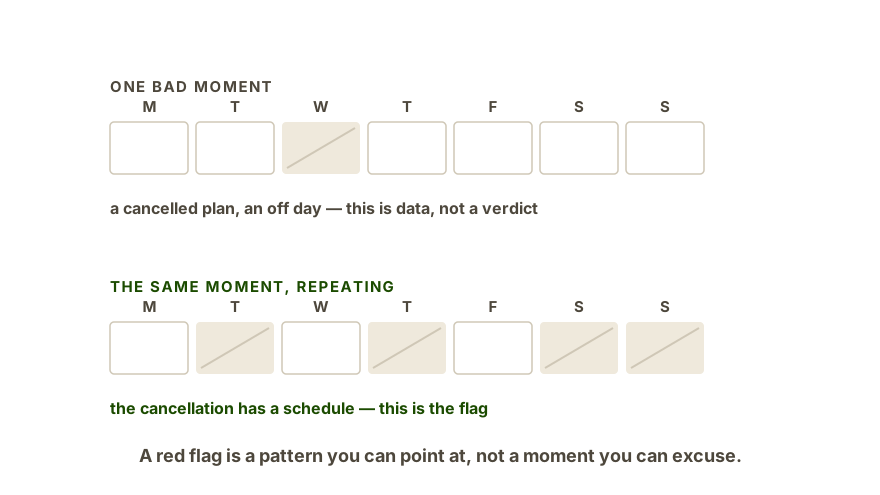
What are the red flags in a talking stage?
Six patterns, each of which needs to happen more than once to mean anything.
A direct question gets deflected twice. You ask what this is, or what they are looking for, and get humour, a subject change, or a compliment instead of an answer. Once is awkwardness. Twice is the answer.
Plans exist only at their convenience. Meeting happens when it suits their schedule, at short notice, and rarely far enough ahead to survive a better offer.
Contact runs on a cycle. Days of constant messages, then a drop, then a return with no reference to the gap. The pattern matters more than the volume.
They exist only over text. Over time, you know their sense of humour and almost nothing about their week, their friends or what they do on a Sunday.
Your questions get reframed as pressure. Asking where something stands is treated as an accusation rather than a question, which makes the next ask more expensive.
What they say and what they do are consistently different. Not once, in a difficult week — as a standing pattern where the stated intention never turns into a change in behaviour.

What do talking stage red flags look like from your own side?
Every pattern above has a version that runs the other way. Six of them carry the same weight, described as behaviours rather than as character.
Implying a commitment you have not decided on. Language that suggests exclusivity to keep someone interested, while you keep your options open, lands as a broken promise later, even if nothing was formally promised.
Testing instead of asking. Deliberately delayed replies, mentioning someone else to gauge a reaction, or hinting rather than stating. Each one substitutes a puzzle for a sentence.
Auditing their life. Response-time monitoring, tracking who they follow, and asking about their weekend in a way that is really a check. Interest and monitoring land very differently on the receiving end.
Making them responsible for your certainty. Repeated requests for reassurance move the work of managing your anxiety onto someone you met recently.
Staying vague on purpose. Avoiding the conversation because the current arrangement suits you, while knowing the other person wants an answer, is the same behaviour that reads as a flag when the other person is the one doing it.
Disappearing rather than declining. Silence is easier than a sentence and costs you nothing socially. It is also the version of an ending that leaves the other person nothing to answer.
What is not a talking stage red flag?
A slow reply. A cancelled plan with a replacement offered. Wanting to move slowly. Not being on social media. Having been hurt before and saying so. A busy fortnight. Sleeping on a big question before answering it. None of these describes an unwillingness to be clear — they describe a person with a life and a pace.
Two more that get miscounted. First, someone saying honestly that they do not want a relationship right now is not a flag; it is information, and it is the kind that is hard to give. Second, a talking stage that has lasted longer than you expected is not by itself a problem. There is no measured norm for the length of one, which is the subject of how long a talking stage should last, and the useful question is whether anything is still changing.
What does ghosting mean during a talking stage, and how common is it?
Ghosting means all contact stops with no explanation and nothing follows — during a talking stage, that means no reply to the next message and no stated ending. It is common enough to be measured: about three-in-ten US adults (29%) say someone they had gone out with suddenly stopped answering their calls or messages without explanation (Pew Research Center, 2020), a lifetime experience across all adults rather than an annual rate. Among US adults aged 18 to 29, regardless of their current relationship status, that figure runs to 42% (Pew Research Center, 2020). Full question wording and base for both: 29% · 42%.
The talking stage is where this happens most easily, because there is nothing to end. No status was agreed, so no conversation feels owed. That is the mechanic, and it explains the frequency without excusing the landing.
What people say they would do is a useful counterweight. In the same Pew Research Center work, 52% of single US adults on the dating market say that after a first date they did not want to repeat, they would not contact the person (Pew Research Center, 2020). They would still let the person know if contacted first. Another 8% said they would not contact the person and would not respond if the person contacted them (Pew Research Center, 2020). Both figures describe a hypothetical intention after a first date, not what anyone reported doing, and Pew does not call either one ghosting. The full family of post-ghosting behaviour has its own page: what ghosting means. Every figure we publish, with sources and bases, sits on our statistics page.
How do you tell a red flag from a difference in pace?
Ask a question that cannot be answered with a mood, such as “What are you looking for at the moment?” or “Are you seeing other people?” Both are answerable in a sentence by anyone who knows their own answer, and neither requires the other person to define the relationship on the spot.
The response is the data. A direct answer, even one you did not want, is a person being clear. A deflection you have now heard twice is also clear, in a way that does not need interpreting. Someone moving slowly can say so, and a direct question is what makes room for that answer. There are more of these on questions to ask during the talking stage.

When has a talking stage stopped being a stage?
When nothing new is arriving. A stage has direction — the amount you know, the distance plans are made ahead, the number of things you have done in person all keep growing. Once those stop changing and the ambiguity itself becomes stable, the thing you are in has quietly changed category, which is the distinction drawn in talking stage vs situationship.
That is not a verdict on anyone. Some people are content in an undefined arrangement and some are not, and both are legitimate positions. What is worth avoiding is being in one by default, having never said which you are. The rest of the talking stage guide covers what the phase is and what usually follows it.
What can you do once you have named a talking stage red flag?
Three moves exist, and none of them requires proving a case. You can ask the direct question and take the answer, including the non-answer, at face value. You can state what you want and let the other person decide, which is a different act from asking. Or you can end it, which needs no fault to point at and no permission to carry out.
What does not work is building evidence. Collecting flags to present later turns a decision you are allowed to make on your own preferences into a trial that needs a verdict. You do not need one. “This is not what I want” is a complete reason.
Are talking stage red flags different when you met on an app?
One measured difference does show up. 53% of US adults who have used online dating say they have been ghosted (Pew Research Center, 2020), compared with 19% of US adults who have never used online dating (Pew Research Center, 2020). Full question wording and base for both: 53% · 19%. Pew reports that as an association, not a cause: nothing in the data says apps make people disappear, and both figures cover a lifetime rather than a year.
What is describable is the setting. A conversation that began in an app has fewer social threads holding it together — no shared friends to explain yourself to, no next class or shift where you will see each other. The flags themselves are identical. The cost of walking away without a sentence is simply lower.
What are the signs it is time to end a talking stage?
Three signs, and none of them requires the other person to have done anything wrong. You asked a direct question and received a deflection twice, so the answer has effectively been given. The arrangement holds only while you maintain it, and stops the moment you stop. Or you have realised, independently of anything they did, that your own answer is no.
Ending here can be short, and it does not have to be delivered as a verdict. A sentence naming what you want and saying this is not it does the whole job. You are not obliged to argue the case, and the other person is not obliged to agree with it.
What can this page not do?
It cannot go past the point where this stops being a dating question. If the situation is producing anxiety that follows you into work and sleep, or thoughts about one person that you cannot put down, that is no longer a dating question and this page has nothing for it. That is a conversation for a doctor or a therapist, and it is worth having regardless of what the other person eventually says. Naming a pattern can settle a question; it does not treat what the pattern is doing to you.