
What does ghosting mean?
Ghosting is ending all contact with someone without explanation and without a goodbye. Dictionary.com defines it as “the practice of suddenly ending all contact with a person without explanation, often in a dating or romantic relationship.” The word covers the method of leaving, not the reason for it. The person may have decided long ago or moments ago; the defining feature is that they did not say so.
In brief: the silence is the definition. Everything below is how to tell it apart from the four behaviours it gets confused with, and what the measured evidence does and does not cover.
Used as a verb, it takes both directions. Someone ghosts you; you got ghosted; the person who does it gets called a ghoster. It applies to friendships, group chats, job applications and landlords too, but the dating sense is the one that made it common vocabulary.
Where does the word come from?
It came up through everyday online speech rather than from a coinage anyone can date. No traceable first-use record for the dating sense could be found, so this page gives none — a first-use date attached to the general noun would be a different word’s history borrowed to look precise.
What is documented is how fast the term spread. As of its October 2019 fieldwork, 62% of US adults said they had heard of the dating term “ghosting” (Pew Research Center, 2020) — awareness of the word, not experience of the behaviour. Recognition of the other dating terms in the same Pew question varied widely; see the numbers page for the full comparison.
How many days of silence count as ghosting?
There is no threshold, and nobody has set one. No dictionary defines ghosting by duration and no survey measures a cut-off, so any figure you see — 48 hours, three days, two weeks — is one writer’s habit presented as a rule.
The workable read is by pattern rather than by clock. Three things together point to contact that has ended rather than paused: a rhythm of replies that was steady stops, a direct question goes unanswered, and no new plan is offered in place of a cancelled one. A quiet weekend is not any of that. For example, someone who answers on Tuesday, goes quiet over a busy weekend and then picks the thread back up on Monday has done nothing the word describes.
How do you know if you’re being ghosted?
You cannot know intent from the outside; you can only describe what changed. What changes, roughly in this order: reply times stretch, then answers get shorter and lose questions of their own, then plans dissolve without a replacement date. Last, a direct question — “are we still on for Friday?” — gets no answer at all, often while the person is visibly active elsewhere.
What that is not: a busy fortnight, a slow texter who has always been a slow texter, or someone who answers everything but never suggests anything. That last pattern has its own name, benching, and it works in the opposite way to ghosting: contact continues at a low level instead of stopping.

How common is ghosting?
It is common enough that it has been measured on a national sample. About three-in-ten US adults (29%) say someone they had gone out with suddenly stopped answering their calls or messages without explanation (Pew Research Center, 2020) — that is all adults, over a lifetime, not a yearly rate.
The experience is not spread evenly by age. Among US adults aged 18 to 29, regardless of their current relationship status, about four-in-ten (42%) said they had been ghosted (Pew Research Center, 2020).
It also tracks with how people meet: 53% of US adults who have used online dating say they have been ghosted (Pew Research Center, 2020), against 19% of US adults who have never used online dating (Pew Research Center, 2020). Pew reports the association, not a cause: it does not follow that apps make people disappear, and a larger pool of near-strangers is a different thing from a different kind of person. Every figure on this page, with its exact question wording and base, is on the statistics page.
Why do people ghost?
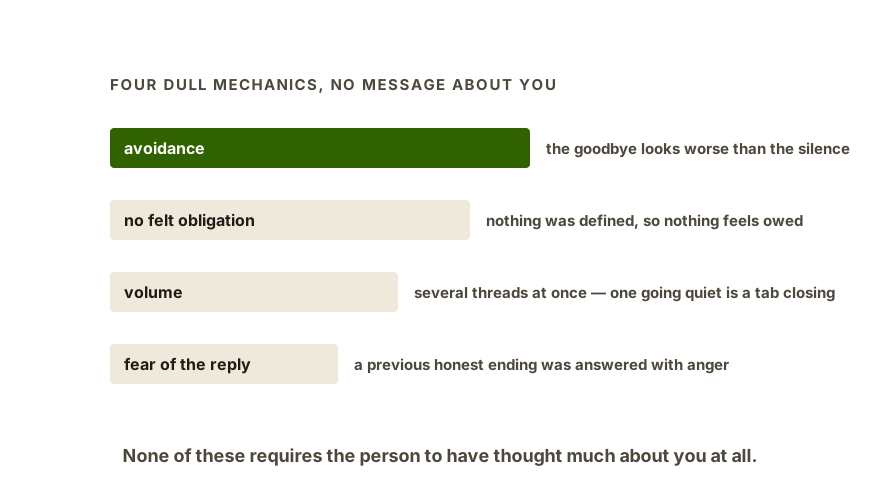
The mechanics are duller than the experience. Four patterns are worth naming, and none of them require the person to have thought much about you at all.
The conversation looks worse than the silence. Saying “I’m not feeling this” to someone who has been kind is a short message that feels, in advance, like an ordeal. Avoidance is a prediction about a conversation, not a judgement of the other person.
The status was never defined, so the obligation was never obvious. In an undefined connection, both people can hold sincerely different views about whether an explanation was owed. That ambiguity is the whole engine of a situationship, and it is why endings there so often happen by subtraction.
Volume. When someone is talking to several matches at once, one thread going quiet does not feel to them like an event. It feels like a tab closing.
Fear of the reply. Some people have had an ordinary “this isn’t working” answered with anger or a long argument. Where there has been aggression or intimidation, cutting contact without warning is a safety decision, and it should not be filed under bad manners.
The closest measured thing we have is what people say they would do after a first date they did not want to repeat. 40% of single US adults on the dating market say they would contact the person and let them know (Pew Research Center, 2020). Another 52% say they would not make contact but would answer if the person contacted them (Pew Research Center, 2020) — a fade-out that still answers, which is not the same as disappearing. And 8% say they would not contact the person and would not respond if contacted (Pew Research Center, 2020). Pew asked about intentions after one date, not about behaviour in an ongoing connection, and Pew never calls any of these ghosting.
What can you do when you’ve been ghosted?
Two responses are worth the effort, and they are the two ends of the range.
Send one message, and make it a question rather than an indictment. Something like: Hey — I haven’t heard from you, and I’d rather know than guess. Are you still interested? One message asks for information. Six messages ask for a reaction, and a reaction is not the thing you actually wanted.
Or send nothing and set your own cut-off. Decide in advance what you will conclude if no reply comes, and then act on that conclusion instead of renewing the deadline. For instance, if you pick the coming Sunday, the point is that the date stops moving, not that a week is the right length. The reason to pick a date is that open threads keep asking to be checked.
Then practicalities, in whatever order helps: mute rather than doom-scroll their profile, or block if muting is not enough. Neither is a statement to them; both are a way to stop giving yourself new information to reinterpret.
The part that is genuinely hard is closure, because ghosting is precisely the ending that does not supply any. You will not get a reason, and if you build one yourself it is likely to be harsher about you than the truth. This is the same problem as ending a situationship from the other side: an undefined thing ends without paperwork, and the absence of paperwork is not evidence about your worth.

What is ghosting confused with?
Four neighbouring behaviours get called ghosting and are not. The slow fade is contact that thins out instead of stopping: replies get shorter and rarer, but the person is still technically answering. Orbiting refers to contact that stops while the watching continues — no replies, but your stories keep getting views. Zombieing means a return after that silence, a message arriving as though the gap never happened; Dictionary.com's dating-slang glossary describes a zombie as “a ghoster who ‘rises from the dead’ and contacts you like nothing ever happened”. Haunting is a lingering presence after an ending — your feed, your notifications, your mutuals’ plans — without anything ever being addressed.
| Behaviour | Contact | Explanation given | What you can observe |
|---|---|---|---|
| Ghosting | Stops outright | None | Replies end; a direct question goes unanswered |
| Slow fade | Thins out, continues | None | Answers get shorter, later, and stop asking anything back |
| Orbiting | Stops, watching continues | None | No replies, but your stories keep being viewed |
| Zombieing | Stops, then resumes | None | A message arrives after the gap as if it never happened |
| Haunting | Stopped, presence remains | None | They surface in your feed, notifications or mutual plans |
Those last three have their own page: zombieing, haunting and orbiting. They share one mechanic — presence without intent — which is what makes them harder to read than plain silence. Our whole dating terms glossary sorts words like these by what they actually describe.
What if it happens in the talking stage or a situationship?
The less defined the connection, the more ordinary the silence looks to the person leaving and the more confusing it looks to the person left. In the talking stage nothing has been agreed out loud, so there is no status to formally end — which is exactly why disappearing feels, to the one doing it, like nothing was broken. It does not follow that nothing happened to you. Daily contact is daily contact, whatever the label was.
In a situationship the same thing lands harder, because there was usually shared time, shared people and a routine to lose. Grief over an unnamed thing is still grief, and the fact that you would struggle to explain the loss to a colleague is a feature of the vocabulary, not a measure of the loss.
One practical note for both: being ghosted answers the definition question you were probably already carrying. If you had been wondering whether the connection was heading somewhere defined, the silence is a reply to that question. It is a poor way to deliver an answer, and it is still an answer.
If you’re the one who wants to disappear
This page addresses both sides, because being ghosted and going quiet on someone are not confined to different sorts of people.
The exit line does not need to be a paragraph or a reason. I’ve enjoyed meeting you, but I don’t want to keep this going. Wishing you well. That is the entire job. You do not owe an explanation of your feelings, a diagnosis of the connection, or a negotiation — and you can send it and then stop replying, which is different from never sending it.
On the method, two figures sit side by side. 87% of US adults say it is always acceptable to break up in person with someone you are casually dating (Pew Research Center, 2020). Another 48% say it is never acceptable to break up by text (Pew Research Center, 2020), such as the one-line message this section suggests. Those are judgements about norms, not reports of behaviour, and they cover breaking up rather than the end of a few dates. Read together they say the public leans towards saying it out loud, and that a text still divides opinion.
The exceptions are real. If someone has been aggressive, has ignored a stated boundary, or has made you uneasy about being findable, ending contact without notice is not a manners question. Do it, and do not audit yourself for rudeness afterwards.
When does being ghosted stop being a dating problem?
An unexplained ending stings, and for a while it takes up more room than it should. That is ordinary, and it fades.
Where this article’s job ends: if the silence has turned into intrusive thinking you cannot put down, sleep you are not getting, or a mood that is affecting work and the people around you, that is not a dating-vocabulary problem. No glossary entry fixes it. A therapist or your doctor is the right address for that, and going is not an overreaction. Naming what happened is useful. It is not treatment.