
What is a delusionship?
Delusionship is internet slang for a romantic connection that lives mainly inside one person’s head. The attachment, the imagined conversations and the future being planned are real to that person; the agreement they belong to was never made. The other party may be a coworker, a friend, someone met twice, or someone who does not know the connection is being counted as one.
In brief: no major dictionary has an entry for this word, and this page treats that absence as the answer rather than papering over it — what follows is the plain-words definition and how the term differs from a situationship.
The word is built to be used about yourself. It turns up as self-applied and rueful, for example someone describing a stretch of reading into replies, in the past tense. Used about another person it becomes a label rather than a description, which is a different act, and this page keeps to the first use.
Is “delusionship” in the dictionary?
No. No major dictionary carries an entry for delusionship. The only dictionary-branded page that holds the word is a Collins New Word Proposal, and those are user submissions pending review, not accepted entries — anyone can file one. If a page tells you the word “was added to the dictionary,” ask which dictionary and check the entry itself.
The comparison next door is instructive. Dictionary.com does have an entry for situationship, defining it as “a romantic or sexual relationship that its participants have not defined, and which can also lack commitment or exclusivity.” It marks the word informal and dates its first recorded use to 2005–10. Situationship was also one of the four finalists for Oxford University Press’s Word of the Year 2023, alongside rizz, which won, plus Swiftie and prompt (Oxford University Press, 2023). Delusionship has none of that behind it.
Where does the word come from?
Nobody has documented a first use, and we are not going to invent one. What can be said is what the word is made of: it is a blend, the way situationship is, with delusional in the front slot instead of situation. Deluluship means the same idea spelled through the slang word delulu, an internet clipping of “delusional” that circulated in fan communities before it turned up in dating talk.
That construction is the whole reason it caught on. The -ship ending now reads as a suffix
meaning “an undefined arrangement of this kind,” so a new word in that shape explains itself on
first sight. That is also why the family keeps growing faster than lexicographers can record it.
What is the difference between a situationship and a delusionship?
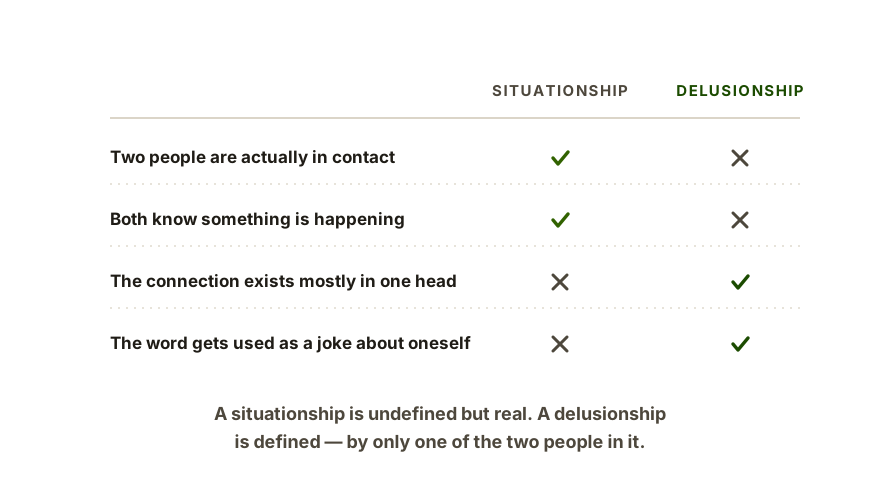
Both words describe a connection with no agreed label, and there the overlap ends. Situationship refers to a connection with two people in it. Neither has defined the thing, but both know it exists, both are participating, and both could name the other person if asked. A delusionship is missing the second participant. One person is in what they experience as a relationship; the other is in an exchange of messages, in a talking stage they read as low-stakes, or in nothing they would name as a connection at all.
The practical test is not how strong the feelings are. It is whether anything has been said out loud, and whether both people would describe the same stretch of time the same way. Where the answers diverge is where the two words separate. The table below leans on the same distinction Dictionary.com's entry draws for situationship alone: a defined word describing an undefined but shared arrangement.
| Situationship | Delusionship | |
|---|---|---|
| How many people are in it | Two | One, functionally |
| Does the other person know? | Yes — they are in it too | Sometimes not, or not in those terms |
| What is missing | A definition | A second participant |
| Who uses the word | Either person, about the pair | The speaker, about themselves |
| Dictionary status | Defined by Dictionary.com, labelled informal | No major dictionary entry |
| What resolves it | A direct conversation about status | A direct question, and accepting the answer |
If the connection turns out to have two people in it after all, the situationship hub is the page that covers the undefined-but-mutual version. Am I in a situationship? walks through telling one from an early-stage relationship without handing out a verdict.

How do people actually use the word?
Three registers turn up in ordinary use. As self-deprecation about the past: that was a delusionship and I was the only one in it. As a warning to a friend mid-story, gently. And as an ordinary noun in captions and video titles, where it functions as shorthand for wanting more than was ever on the table.
What it is not used for, in normal speech, is describing someone else’s mental state. The word borrows a clinical sound and drops the clinical meaning entirely — the same move as calling a busy week insane. Reading a psychiatric claim into it misreads the register.
How common is the word?
No survey has asked about it, so any number attached to delusionship is somebody’s estimate. Awareness of dating vocabulary has been measured for some terms: as of its October 2019 fieldwork, 62% of US adults said they had heard of the dating term “ghosting” (Pew Research Center, 2020) — awareness of the word, not experience of the behaviour. Nothing equivalent has been published for delusionship. Our numbers page lists what has and has not been counted.
The safe assumption is that delusionship is understood inside the places it circulates and blank outside them. Using it in a conversation with the person involved is likely to need a translation first, which rather defeats the point of a shorthand.
What can you do if the word fits your situation?
One thing changes the picture, and it is unglamorous: asking directly and treating the answer as information. “I’ve been reading this as something — where are you at with it?” is a question with a usable answer in every direction, including an awkward one. The terms glossary has the neighbouring words if what is happening turns out to have a different name, such as benching, where the other person is present but keeping the option open.
Two things do not work. Waiting for a signal clear enough that no question is needed — the whole shape of the situation is that signals stay readable both ways. And escalating contact, which adds volume without adding information.
If the answer comes back as “I like you as a friend” or as a fog, that is still an answer. What you do with it is a separate decision, and a slower one than the internet’s version of this word suggests.

Is a delusionship a mental health problem?
No. Delusionship is a slang word for a mismatch of expectations, not a psychological condition: it does not appear in any clinical manual, and no article can tell you what is happening in anyone’s mind, including your own. Mismatched expectations are an ordinary thing to have and to survive.
There is a line where an article’s job ends. If thoughts about a person are running most of your day, disturbing your sleep, or making work and friendships hard to hold onto, that is not a vocabulary problem and no dating term will resolve it. A licensed therapist or your doctor is the right place for that, and going is not an admission that the feelings were foolish.