
Situationship vs friends with benefits is not a difference in what the two people do. It is what each person is allowed to expect. Friends with benefits is an arrangement that has been named and given a ceiling. A situationship is a connection that has never been named at all, so the ceiling is whatever each person privately assumes.
What is the difference in one sentence?
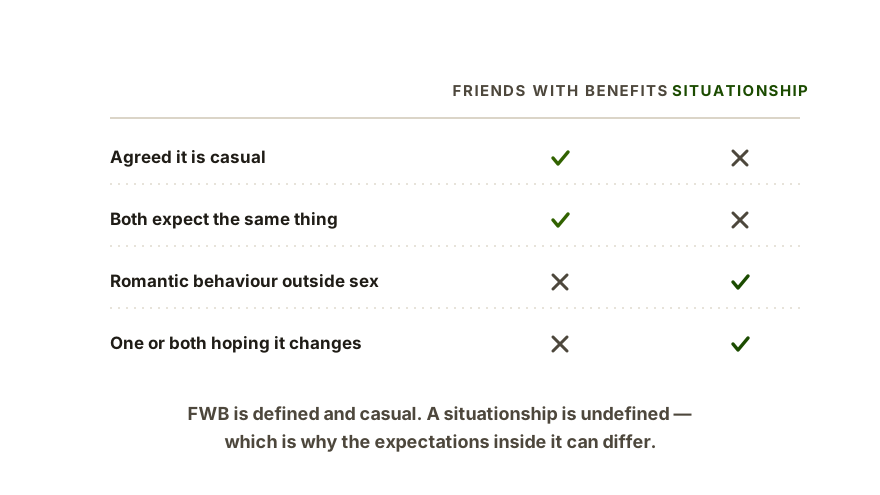
Friends with benefits is a stated arrangement with a stated limit; a situationship is an unstated connection with no stated limit. Both can involve regular contact, affection and time together. Only one of them has a sentence that both people have actually said out loud about where it stops.
In brief: friends with benefits has a spoken ceiling and a situationship does not — that single gap, not the behaviour, is what separates the two labels.
What does “friends with benefits” actually mean?
Friends with benefits describes two people who are — or present themselves as — friends and who have added a physical element without either treating it as the start of a relationship. The label carries its own terms: the friendship is the frame, the arrangement is understood to be finite, and neither person is officially pursuing the other. The terms come with the label, which is part of why people reach for it.
What does “situationship” mean by comparison?
Dictionary.com defines a situationship as “a romantic or sexual relationship that its participants have not defined, and which can also lack commitment or exclusivity”, labels it informal, and dates the word’s first recorded use to 2005–10. The operative word is undefined. Where friends with benefits announces its limits, a situationship declines to announce anything, including whether limits exist. Our plain definition of a situationship goes through the term in full.
Where does the line actually fall?
Four axes separate them, and only the first one does real work. The rest follow from it.
Was it named out loud?
Friends with benefits is a label people use to each other’s faces — “we’re friends, this is what this is”. A situationship is characteristically the arrangement nobody wants to name, because naming it would require answering the follow-up question. If you cannot recall a conversation in which the terms were said aloud, you are on the situationship side of the line regardless of what the pattern looks like.
What is each person hoping for?
An FWB arrangement assumes both people want the same limited thing and have said so. A situationship makes no such assumption, and can contain two different hopes running in parallel: one person waiting for it to become a relationship, the other treating it as already complete. Neither hope is stated, so neither gets corrected.
Does anyone else know?
Friends with benefits is private by design, and it is not presented to other people as a couple. Situationships vary widely here — consider a couple who invisibly meet up once a week versus one who shows up to group dinners, holidays, and a photo everyone has an opinion about. Visibility is a weak signal on its own, but a wide gap between how you two behave alone and how you are described to others is worth noticing.
Is the future part of the conversation?
In an FWB arrangement there is no future to discuss, and both people know that going in. In a situationship the future is the live question that keeps not being asked. That single difference — a closed question versus an open one — is most of what separates how the two feel from the inside.
How do they compare side by side?
| Axis | Friends with benefits | Situationship |
|---|---|---|
| Has it been named? | Yes — both people have said what it is | No — the naming conversation is the one that has not happened |
| Starting point | An existing friendship that adds a physical element | A romantic connection that never got defined |
| Stated ceiling | There is one, and both people agreed to it | None stated; each person assumes their own |
| Exclusivity | Not assumed unless someone says otherwise | Sometimes exclusive in practice, unconfirmed in words |
| Visible to others | Private by design; not presented as a couple | Varies — sometimes fully public, sometimes invisible |
| Where it breaks down | One person outgrows the agreed ceiling | The gap between two unspoken expectations shows up |
Why do people mix the two up?
Because from the outside the behaviour can look identical, and behaviour is what people compare. Two people texting daily, seeing each other weekly and telling nobody could be either. What differs is invisible from the outside and often invisible from inside as well: whether an agreement exists. That is why “are we FWB or a situationship?” is not settled by listing what you do together — the list comes out the same either way.
There is also a vocabulary gap. Pew Research Center’s October 2019 survey of US adults found 89% said they had heard of the term “friends with benefits” (Pew Research Center, 2020), while 62% said they had heard of “ghosting” (Pew Research Center, 2020) — awareness of the words themselves, not of anyone’s experience. The older label is the more widely recognised one. Newer terms are still settling, so people reach for the familiar one to describe something it does not quite fit. The numbers we use and where they come from are listed with their sources.

Can one turn into the other?
Both directions happen. For instance, an FWB arrangement drifts toward situationship territory when one person’s wants change and the agreement is not renegotiated. The old terms are still technically on the table, but they no longer describe what at least one person is doing. A situationship moves toward FWB clarity only when somebody states a ceiling and the other person accepts it. Both transitions require the same thing: a sentence said out loud. Neither happens by accumulation of time.

Which one is better?
Neither, and the question hides a different one. What people mean by “better” is “which one hurts less”, and the answer depends entirely on what you want. If you want a limited arrangement, a named one is easier to hold than an unnamed one. If you want a relationship, then both labels describe something that is not it yet, and the distance is covered the same way in either case.
Ranking them also assumes the two people involved want the same thing, which is exactly the assumption that breaks. Pew Research Center reported in 2023 that among US adults who had used a dating site or app in the past year, 40% said dating casually was a major reason (Pew Research Center, 2023) they used them. In the same survey, 44% said meeting a long-term partner was (Pew Research Center, 2023) a major reason, and respondents could give more than one reason. Both motives sit in the same pool of recent users. Two people can meet there carrying different pictures of what happens next and never compare them.
How do you ask which one this is?
You ask about the terms, not about feelings, and you ask in one sentence. “I want to know what we’re calling this — are we friends who sleep together, or is this going somewhere?” gives the other person a real question with two answerable options, which is harder to deflect than “what are we?” Say it in a normal moment rather than in the middle of a disagreement, and be ready for a plain answer you did not want.
An evasive reply is itself information, and it is worth reading carefully rather than retrying. “Let’s not put a label on it”, “I’m not looking for anything serious but I like this”, and “can we talk about this later” all answer the ceiling question: for now, there is one, and it has just been described without being named. What you do with that is a separate decision, and it is yours — the answer tells you which arrangement you are in, not what you have to accept.
Why do the labels matter at all?
Not for status. A label matters because it tells you which question is still open. “Friends with benefits” answers the question in advance, so the thing to watch is whether the answer still fits. “Situationship” leaves it open, so the thing to watch is whether the open question is costing you anything. Knowing which of those two jobs you have makes the next step obvious in a way that a general sense of unease does not.
If you are unsure which side of the line you are on, the checklist in am I in a situationship? works through the signs without issuing a verdict. If the comparison you actually want is against a defined relationship rather than a defined arrangement, that is situationship vs relationship. And if this is early enough that neither word may apply yet, the boundary case is talking stage vs situationship.
Where this page stops
This page describes how two labels are used and what separates them. It does not tell you which one you should accept, because that depends on what you want, and nobody can read that off a comparison table. If the uncertainty in this connection has turned into anxiety that follows you into the rest of your week — sleep, work, the people around you — that is outside what an article about vocabulary can help with, and a therapist or counsellor is the right place to take it.