
What do zombieing, haunting and orbiting mean?
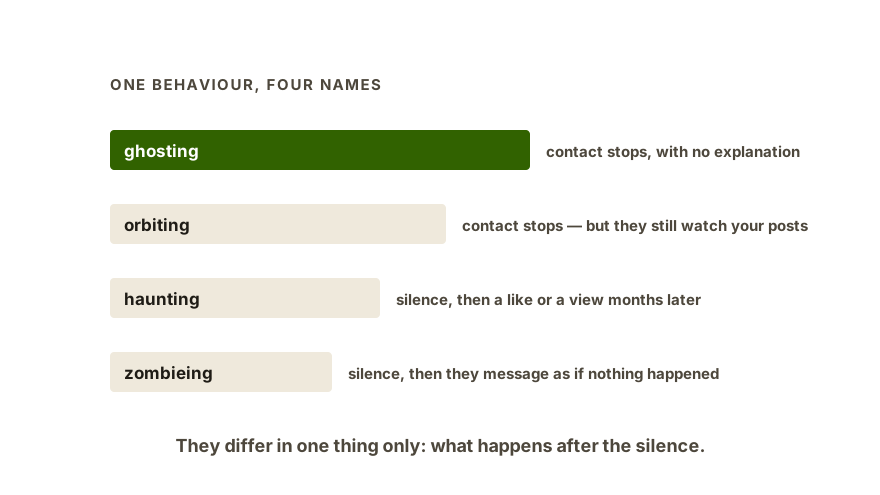
Ghosting is the disappearance; zombieing, haunting and orbiting are three of the things that happen after it. Zombieing is the return of someone who vanished, opening a chat as though no gap existed. Haunting means presence without contact — they stay in your feed, your notifications and your mutual plans while saying nothing. Orbiting refers to silence in messages combined with continued watching of your posts.
In brief: all three name what can follow ghosting rather than ghosting itself, and only one of the three — zombieing — has an authoritative definition to attribute; the others are written in this site’s own words below.
All three describe the same odd condition: the connection ended, and the person did not fully leave. That is why they are harder to read than plain silence. Silence at least answers a question.
| Term | What has stopped | What continues | Usual first sign |
|---|---|---|---|
| Ghosting | All contact, without explanation | Nothing | A direct question goes unanswered |
| Zombieing | Contact, at some earlier point | Nothing — until a message arrives | A casual text after a gap |
| Haunting | Conversation | Their presence around your life | They keep appearing where you are |
| Orbiting | Replies and plans | Watching your posts and stories | Views and likes with no messages |
| Slow fade | Nothing abruptly | Thinner, slower replies | Answers shrink and stop asking anything |
| Benching | Progress towards plans | Low-level friendly contact | Warm messages, no dates offered |
What does zombieing mean in dating?
Zombieing is when someone who ghosted you comes back and behaves as though they never went anywhere. The message is short and light — a reaction to a story, a “hey stranger”, a meme. Dictionary.com's dating-slang glossary describes a zombie as “a ghoster who ‘rises from the dead’ and contacts you like nothing ever happened.” The disappearance is not mentioned, and often nothing in the message acknowledges that time passed at all.
The word is built on the horror-film image rather than on anything about the person’s motives. It describes a re-entry, not a plan. Someone can zombie you after a short gap or a long one; the gap length is not part of the definition. What makes it zombieing rather than an ordinary reconnection is the absence of any reference to the silence.
There is also a practical marker that separates zombieing from a genuine attempt to repair something. A repair names the gap: I went quiet and that wasn’t fair, I’m sorry. A zombie message skips straight to the present tense. Both can arrive from the same person on the same day, which is why the safest read is the one that waits a beat before answering.
What does haunting mean in dating?
Haunting is the sense that someone who ended things is still around, without ever making contact. They watch your stories, appear in the same rooms and group chats, get mentioned by mutual friends, turn up in your recommended follows. Nothing is said. Nothing has to be said for the presence to be felt.
We define haunting here in our own words on purpose. No dictionary or publisher glossary we opened carries a definition of the dating sense, so there is nobody to attribute one to, and inventing a source would be worse than saying that plainly. If you searched this word and landed on pages about spirits and old houses, that is the collision the slang lives with: the dating sense has no reference entry to outrank the literal one.
The functional difference from orbiting is who does the noticing. Orbiting is a specific behaviour you can point at — the view, the like, the follow that stayed. Haunting is broader and partly ambient: it includes the traces a shared life leaves behind, the photos still up, the friend group that did not split. Some of what feels like haunting is simply two people with overlapping worlds and no ceremony to mark the ending.
What is orbiting in dating?
Orbiting is when someone stops replying to you but keeps consuming what you post. Dictionary.com's dating-slang glossary defines orbiting as “when someone breaks off all contact with a person they were dating in real life, but they continue following that person on social media.” The messages end and the attention does not.
In practice it shows up as views on your stories, a like on a photo, an emoji reaction to something you posted — from an account that has not answered a direct question. The mismatch is what makes it disorienting. Attention normally reads as interest, so a channel that keeps delivering attention while delivering no answers keeps a question open that silence alone would have closed.
The metaphor is exact enough to be useful: an orbit is proximity without approach. It does not tell you whether the person is deciding, curious, or simply has not thought about it. From the outside those three look identical, which is the honest limit of what the term can tell you.
What do zombieing, haunting and orbiting have in common?
Presence without intent. In each case there is enough contact to keep you interpreting and not enough to answer anything. That is the shared mechanic, and it explains why these three feel harder to resolve than being ghosted outright: a closed door is information, while a door left ajar is a task you keep returning to.
It also explains the second shared feature, which is that none of them require a decision from the other person. A zombie message can be sent by someone who has not thought about you since the last one. An orbit costs nothing to maintain — the app keeps the follow whether or not anyone means anything by it. Reading these behaviours as messages assumes a deliberateness that often is not there.
How common are zombieing, haunting and orbiting?
Nobody has measured them. There is no national survey of how often people resurface, orbit or linger, and any percentage you find attached to those three words traces back to a brand poll rather than to a population sample. We would rather leave that blank than fill it.
What is measured is the disappearance underneath. About three-in-ten US adults (29%) say someone they had gone out with suddenly stopped answering their calls or messages without explanation (Pew Research Center, 2020) — that is all adults, over a lifetime, not a yearly rate. Among US adults aged 18 to 29, regardless of their current relationship status, about four-in-ten (42%) said they had been ghosted (Pew Research Center, 2020).
The pattern also tracks with how people meet. 53% of US adults who have used online dating say they have been ghosted (Pew Research Center, 2020), against 19% of US adults who have never used online dating (Pew Research Center, 2020). Pew reports an association and not a cause. The question wording and base for every figure on this page is on the statistics page.
One more thing worth knowing about these words: awareness of the vocabulary is not the same as experience of the behaviour. As of its October 2019 fieldwork, 62% of US adults said they had heard of the dating term “ghosting” (Pew Research Center, 2020) — awareness of the word, not experience of the behaviour. No comparable awareness figure exists for its three sequels, so a person using them in conversation may need to explain them first.
Which one am I dealing with — ghosting, zombieing, haunting or orbiting?
Ask what is still arriving. Nothing at all is ghosting. A message after a long gap, with no reference to the gap, is zombieing. Views, likes and follows with no replies is orbiting. A felt presence with no digital or verbal contact at all — shared rooms, shared people, things they left in your life — is closer to haunting.
Two states get sorted into this family and do not belong. Warm, regular messages that never turn into plans are benching, where contact continues at a low level rather than stopping. And replies that grow thinner over weeks until they stop are a slow fade, which is an ending in progress rather than an aftermath.
Dictionary.com defines ghosting as “the practice of suddenly ending all contact with a person without explanation, often in a dating or romantic relationship” — the without-explanation part is what all four of these terms inherit. None of them come with an explanation attached, which is why naming which one you are in is the only clarity available from your side.
Why do people zombie, orbit or linger?
The mechanics are duller than the experience, and none of them are verdicts about anyone.
Reappearing costs nothing. Sending a light message to a name in an old thread takes almost no effort and does not require having thought about the consequences. That is why a zombie message so often arrives without any account of the silence: for the sender there was no event to account for.
Following is a default, not a decision. Unfollowing is an action; leaving a follow in place is the absence of one. A person can keep watching your stories without ever choosing to.
Circumstances change and old threads are the easiest ones to open. Consider a break-up, a quiet month or a moved city — the person who resurfaces is often responding to something in their own life rather than to a reassessment of yours.
Endings without a definition never got a formal close. In an undefined connection there was no status to end, so nobody was required to announce anything. That gap is the engine behind most of what happens on this page, and it is the same one that makes a situationship hard to describe to other people.

What can you do about zombieing, haunting or orbiting?
The options are short, and the choice is yours rather than a matter of correctness.
If someone zombies you, you can answer, ignore, or ask. Answering restarts a conversation on their terms. Ignoring is a complete reply. Asking is the middle option and the one that produces information: Good to hear from you — what happened back then? How that question is handled tells you more than anything else in the exchange.
If someone is orbiting, decide about the channel, not the person. Muting stories, removing a follower, or going private are settings changes, not statements. You do not owe anyone an announcement, and none of them are hostile acts.
If it feels like haunting, reduce the surfaces before you reduce the people. For example, archive the photos, mute the tags, or skip the one recurring event for a while. Cutting mutual friends is a large action; adjusting what reaches you daily is a smaller one, and it is the one you can undo.
Set your own cut-off in advance. Decide what you will conclude if nothing arrives by a date you pick, then act on that conclusion instead of renewing the deadline. Open threads keep asking to be checked, and the checking is what costs.
If the ending itself is what you are carrying rather than the aftermath, getting over a situationship covers the harder part: grief for a connection that never had a name is still grief.

What about oystering, roaching and the other terms?
The post-ghosting family keeps growing, and the newer arrivals tend to circulate without a reference entry to point at. Oystering circulates as slang for treating the end of a relationship as an opening and going out looking for new connections. Roaching circulates as slang for hiding the fact that you are seeing several people at once. Both are described here in plain words rather than quoted from a dictionary — and a term nobody can look up is a term you may need to explain mid-conversation.
Two neighbouring words do have documented definitions and their own pages: benching, and the family of behaviours around ghosting itself. Our dating terms glossary sorts the whole vocabulary by what each word actually describes, including the ones we have deliberately left out. If this started during early messaging rather than after a defined ending, talking stage red flags covers the same behaviours at an earlier point.
Where does this page’s job end?
Naming the behaviour is useful and limited. Knowing that what you are experiencing is called orbiting does not tell you what the other person means by it, and no page can supply that.
If the situation has moved past irritation into something that runs your days — sleep going, checking the app compulsively, thoughts about one person crowding out work and friends — that is no longer a question about dating vocabulary. A therapist or your doctor is the right place for it. This page describes what words mean. It does not assess anyone’s state of mind, including yours.