
What are situationship rules?
Searches for situationship rules are looking for a code of conduct: how often to text, when to sleep over, how long to wait before asking what this is. Situationship rules refers to the idea of a shared code of conduct for an undefined arrangement — and no such code exists, for reasons that are structural rather than moral. Dictionary.com defines a situationship as an arrangement its participants “have not defined”, so there is no agreement for rules to sit inside by that definition alone. Many people arrive already wanting different things without saying so (Pew Research Center, 2023), which is part of why no shared code could exist in the first place. What you can set are limits — yours, describing your own conduct — and this page is about which ones are worth naming and what to do when one gets crossed.
In brief: this page settles that there is no agreed rulebook for a situationship, only your own limits, and it covers which limits are worth naming out loud and what to do once one is crossed.
What are the rules of a situationship?
There are none that both people agreed to. Every list of situationship rules circulating online is someone’s personal limit written in the imperative: don’t text first, don’t stay over, don’t be the one who asks what this is. Those are preferences dressed as norms. A rule only functions when two people have accepted it, and accepting terms is precisely the step that has not happened in an undefined arrangement — that is what makes it one. See what a situationship is for the definition the rest of this rests on.
This has one practical consequence worth holding on to. In a named relationship, the label does some of the work: it arrives carrying expectations that neither person has to negotiate line by line, whatever those turn out to be for the two of them. Remove the label and that shortcut goes with it. Nothing is included by default. That is neither generous nor unfair; it is just what an undefined arrangement is.
What is the difference between a rule and a limit?
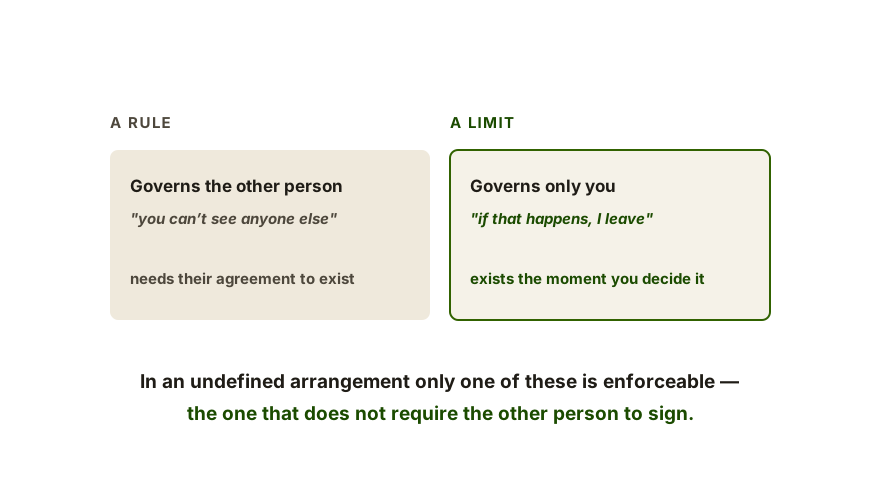
Most advice calls both of these situationship boundaries, and the word is fine until it hides the difference that decides whether the thing works. A rule is a demand on someone else’s behaviour. A limit is a statement about your own. “Text me back within the hour” is a rule, and it needs their agreement to mean anything. “I’m not keeping Saturdays open for plans that get confirmed on Saturday afternoon” is a limit, and it works whether or not they agree, because you are the one who executes it.
The distinction matters here more than in a defined relationship. Rules require an agreement to enforce them, and an agreement is the one thing this arrangement does not have. Limits require only that you say what you will do and then do it. That is why the same sentence lands so differently depending on which side of the line it falls: one asks for authority you have not been given, the other reports a decision you have already made.
| Aspect | Rule | Limit |
|---|---|---|
| Governs | The other person's behaviour | Your own behaviour |
| Needs their agreement? | Yes — a rule without agreement means nothing | No — it works whether or not they agree |
| Example phrasing | "Text me back within the hour" | "I will stop holding Saturday evenings open if plans keep moving" |

Which limits are worth naming out loud?
Not everything needs stating. These are the ones where an unspoken version causes trouble, because the other person cannot infer them and will fill the gap with their own assumption.
- Exclusivity, in both directions. Whether you are seeing other people and whether they are. Assumed exclusivity is a mismatch that stays invisible until it is not.
- How much of your calendar stays open. Such as which nights, and how much notice you need — a specific limit rather than a feeling about being a low priority.
- What happens with last-minute changes. What you will do the second and third time a plan dissolves an hour before it starts.
- Whether you will keep having the same conversation. How many times you are willing to raise the status question before you treat repeated non-answers as the answer.
- What you tell other people. Whether you are describing this to friends, family or a feed, and how. Partial visibility has its own vocabulary; see soft launch.
- What you will not do to hold someone’s attention. Cancelling your own plans, staying awake for a reply, competing with an unnamed other person.
Two of these — exclusivity and the status question — are load-bearing. The rest are comfort. If you only ever say one thing out loud, make it one of those two.
How do you say a limit without turning it into an ultimatum?
State the limit and stop talking. An ultimatum is a statement that attaches a consequence for them (“if you do that again, we’re done”); a limit attaches a consequence for you instead (“if plans keep moving the same day, I’ll stop holding the evening”). The first invites a negotiation about whether you are being fair. The second does not require their vote.
Directness is harder than it sounds, and the one adjacent thing anyone has measured suggests it is not what people reach for first. 40% of single US adults on the dating market say they would contact a person to let them know if they decided, after a first date, that they did not want to go out again (Pew Research Center, 2020). That is a hypothetical about one first date rather than about an established arrangement, so it does not describe what happens inside a situationship. What it does show is that even in that easy case, fewer than half of the people asked said they would say the plain thing. Saying it anyway costs you nothing socially and gains you information. See the source.
Timing matters less than people fear. There is no point at which a limit becomes premature. The worst version is the one delivered as a summary of accumulated grievance, because by then the sentence is carrying resentment it was never designed to hold.
What is allowed in a situationship?
Whatever both people have actually said yes to, and nothing that only one of them assumed. That sounds severe, but it is the practical reading of an undefined arrangement: since no word was applied, no standard package arrives with it. Not exclusivity, not a minimum contact frequency, not a right to know where someone was on Friday. All of that becomes part of the arrangement the moment it is stated and agreed, and not one minute earlier.
Neither is anything forbidden by default. This cuts in both directions, and it is why so much hurt here comes from a mismatch rather than a betrayal. Two people who never compared their definitions were both operating within the terms as they understood them.
Why do two people end up with different limits?
Because they often arrived wanting different things and never said so. 44% of US adults who have used a dating site or app in the past year say meeting a long-term partner is a major reason they used them (Pew Research Center, 2023). In the same Pew survey, 40% of past-year users say dating casually is a major reason (Pew Research Center, 2023). Respondents could pick more than one reason, so these groups overlap rather than compete, and neither figure describes daters in general — the base is the small share of adults who used an app in the past year. See both, with the method.
Arriving without a fixed aim is ordinary too. 26% of US adults who are not in a committed relationship say they are looking for either a committed relationship or casual dates (Pew Research Center, 2020). Someone who is genuinely open to both is not being evasive when they cannot tell you which this is. They may not know yet, and a limit is how you handle that without waiting to find out. See the source.
What do you do when a limit gets crossed?
Work through it in this order, because the order stops the conversation becoming a trial.
- Check whether it was ever stated. An implied limit cannot be knowingly crossed. If it lived in your head, this is the moment it moves out of your head — not the moment for a grievance.
- Say the specific thing, once, close to when it happened. One event, described plainly. Not a pattern, not a list, not a character summary.
- Watch what happens the next time, not what is said this time. An apology is a sentence. The following week is data.
- Do the thing you said you would do. This is the whole mechanism. A limit that is announced and then not executed teaches the other person, accurately, that it was a request.
- Decide what the repetition means for you. Repeated crossings after a clear statement are information about the arrangement’s limits, not a verdict about the person.
If the answer is that you want the status settled, the direct conversation lives on turning a situationship into a relationship. If the answer is that you are done, how to end a situationship covers the wording.

Do numbered dating rules apply to a situationship?
Consider the rules built around a count — of dates, of months, of texts before replying. They circulate in several incompatible versions, none of which traces to anyone who measured anything. They persist because a number feels like an answer, and the underlying question is genuinely uncomfortable: how long is too long to stay in something undefined? There is no published figure for how long these arrangements run, so any threshold you are handed is invented. We do not publish one either.
The workable substitute is not a count but a condition: how many times you are willing to raise the status question and receive a non-answer. That is a limit you can actually set, because it depends on you rather than on a calendar.
What are the signs someone has no limits of their own?
They describe their preferences only after hearing yours. No request from you ever meets a plain no. Their week reorganises around whoever asks last. Plans they made independently dissolve without being mentioned. The pattern is easy to mistake for enthusiasm, and early on it reads as generous.
Describe it as a pattern rather than a personality. People who normally hold their ground lose it temporarily around an outcome they want badly, and this is one of the situations that does it. If the person with no limits is you, that is not a defect either; it is the ordinary effect of wanting something you cannot ask for directly yet.
When does a situationship need a professional rather than a boundary?
When the arrangement stops being a scheduling problem and starts being a state you cannot put down. The markers are practical: sleep that does not come, work you cannot hold your attention on, checking a phone in a loop you have already decided to break, thinking that continues after you have decided to stop.
Setting limits is a communication technique. It is not treatment, and no article can tell you what is happening inside your own head. If a connection is affecting your sleep, your work or how you function day to day, that belongs with a doctor or a licensed therapist rather than with a page about vocabulary. Nothing here is a diagnosis.