
Questions to ask your situationship are not tests, and they are not leverage — they are requests for information you are entitled to have: what this is called, whether other people are in the picture, and what each of you wants next. Dictionary.com defines a situationship as “a romantic or sexual relationship that its participants have not defined, and which can also lack commitment or exclusivity” — so the missing piece is a definition. A question is the only tool that produces one.
What questions should you ask your situationship?
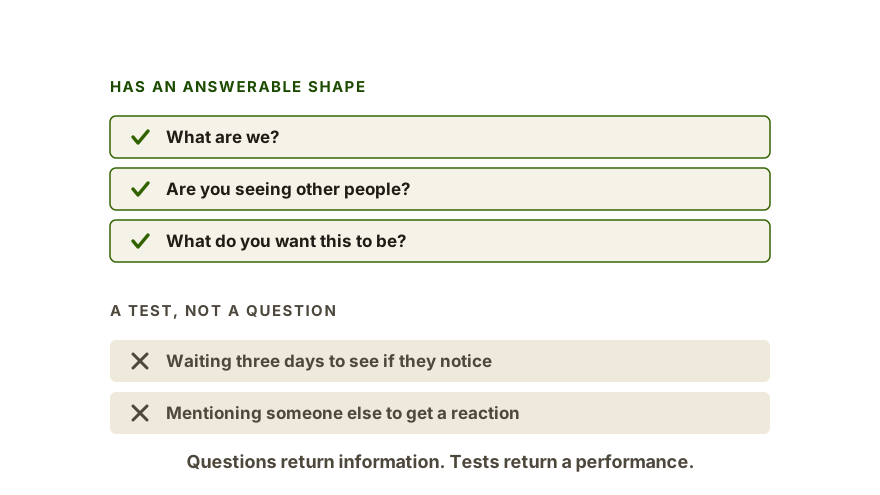
Four questions carry this conversation: What would you call this? Are you seeing anyone else? What do you want this to be? Is that something you want with me? Each one has an answerable shape — a yes, a no, a word, or a visible refusal to give any of the three. That last outcome is not a failed conversation. It is a result.
In brief: the questions worth asking are the ones with an answerable shape, asked once, at a calm moment — and a vague reply counts as an answer, not as a reason to keep waiting.
Questions that do not have that shape tend to produce reassurance instead of information. For example, Do you like me? invites a yes, and a yes there is compatible with nothing changing at all. Where is this going? invites a forecast, and people give forecasts generously because forecasts cost nothing. The difference between the two sets is whether the answer would tell you what to do on Monday. That gap matches Dictionary.com’s own definition of a situationship as a connection its participants “have not defined” (Dictionary.com) — the four questions above are simply that definition asked out loud instead of left standing.
How do you ask without turning it into pressure?
State your own position first, then ask theirs. “I like this and I want it to be a relationship — is that what you want too?” is a question and a disclosure in one sentence, which makes the exchange symmetrical rather than an interrogation. Pressure comes from the frame, not the directness: an ultimatum attaches a consequence to the answer before the answer arrives, while a question just asks for it.
Two practical points. Ask when neither of you is about to leave, undress or fall asleep, because the setting decides how much room the answer has. And ask once. A question repeated weekly stops being a question and becomes a campaign, and campaigns get managed rather than answered. If you want the longer version of this conversation, turning a situationship into a relationship covers the mechanics.

What does an evasive answer mean?
An evasive answer means the person is not willing to say a word out loud right now. That is useful, and it is not the same as a no about their feelings — it is a no about the label as of today. “Let’s not put a label on it”, “I’m not really thinking that far ahead”, “why do we need to define it” are all versions of the same reply: the arrangement stays undefined, and you now know that continuing means continuing on those terms.
The common error is to hear evasion as a delay and start waiting. A vague answer is information with a date on it, not a promise with a deadline. You can decide to stay in an undefined arrangement with your eyes open, set your own limits inside it, or end it. All three are available. What is not available is a phrasing that converts an unwilling answer into a willing one.
| The question | A clear answer | An evasive answer |
|---|---|---|
| What would you call this? | A word: dating, seeing each other, my girlfriend, a situationship | 'Does it need a name?' · 'I don't like labels' |
| Are you seeing anyone else? | Yes, or no | 'Nothing serious' · 'Not really' · a question back |
| What do you want this to be? | A stated want, even one you dislike hearing | 'Let's see where it goes' · 'I'm bad at planning' |
| Is that something you want with me? | Yes, no, or 'not now, and here is why' | Warmth with no answer inside it |
| Where do you stand on exclusivity? | A position both of you could repeat next week | Agreement in the moment, unrepeated later |
What should you text a situationship, and what is not worth sending?
Text like someone with a life: things you saw, plans you actually want, replies that match your real interest rather than a rationed version of it. The messages worth skipping are the strategic ones — for instance, the deliberately delayed reply, the story posted for an audience of one, or the “haha nvm” that retracts a real question halfway through. They work as mood management and fail as information gathering, because they are designed to avoid the answer they are fishing for.
The one message worth composing carefully is the direct one. It can be short: “I want to know what this is for you — can we talk about it this week?” Sending it by text is fine as a request for the conversation. Having the whole conversation by text is harder, mostly because the pauses between messages get read as meaning they may not carry.
How often do you text a situationship?
No one has measured how often people text a situationship, so any recommended frequency you are handed is invented rather than observed. What is measurable is why people arrive in undefined arrangements at all: Pew Research Center found in 2023 that 44% of US adults (Pew Research Center, 2023) who had used a dating site or app in the past year said meeting a long-term partner was a major reason they used them. In the same survey, 40% of that same group (Pew Research Center, 2023) of past-year users said dating casually was a major reason. Respondents could choose more than one reason, so the two figures do not compete — they describe a pool of people arriving with different goals and no obligation to announce them. Both figures, with their method, are on our statistics page.
The practical version: rhythm only matters when it is asymmetric in a way that costs you something. Replies that arrive only after midnight, or only during weeks when other plans fall through, are a pattern worth naming in a sentence rather than decoding in your notes app.

What if your situationship ghosted you?
Ghosting is common enough to be ordinary, which does not make it pleasant. Pew Research Center reported in 2020 that about three-in-ten US adults (29%) (Pew Research Center, 2020) said someone they had gone out with suddenly stopped answering their calls or messages without explanation. Among US adults who have used online dating, Pew put that figure at 53% (Pew Research Center, 2020). Neither number tells you what happened in your case, and neither is a reason to treat the silence as a puzzle with a solution.
A workable sequence: send one message that names the fact and asks for an answer — “I haven’t heard from you in a while. I’d rather know if this is done.” Then stop, and set the outcome yourself if nothing comes back. Silence following a direct question is an answer to the question you asked. Our page on ghosting covers the mechanics on both sides, including what tends to happen if the person resurfaces.
Which questions are not worth asking?
Anything designed to produce a reaction rather than an answer. “Would you be jealous if…”, mentions of an invented rival, tests of whether someone notices your absence: these change behaviour temporarily and tell you nothing about intent, because they measure someone’s response to a scenario rather than their position on the arrangement. They also make the eventual real conversation harder to have, since the other person now has a reason to guess at what a question is really for.
The same goes for question lists sold as compatibility checks. A long list of deep questions can produce a pleasant evening and leave the status exactly where it was. One question about the status changes what you know. The talking stage is the earlier period when you are still figuring out whether there is anything to define at all — if that is where you are, the talking stage questions page is built for that stage instead.
Where this article stops
This page covers what to ask and how to read the reply. It does not cover the part where the ambiguity has taken over the rest of your week: intrusive thoughts about someone’s phone, sleeplessness, checking behaviour you cannot stop. That is not a communication problem and no wording fixes it. If that is where you are, a therapist or your doctor is the right address, and saying so plainly is more useful than another script. The broader picture of what these arrangements are sits on our situationship hub.