
What is a soft launch relationship?
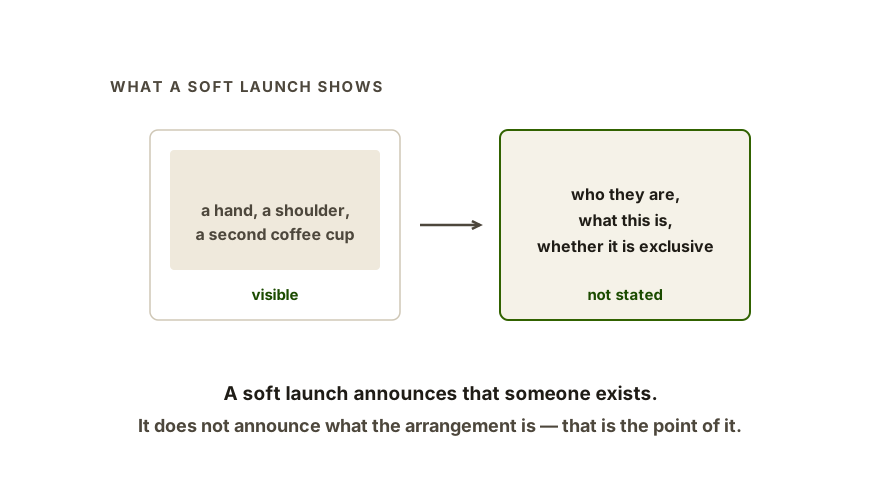
A soft launch relationship is one that has been hinted at publicly without being identified. You post a second coffee cup, a hand, a blurred figure at the far end of a beach, and the people who follow you work out that someone exists. Dictionary.com gives soft launch a relationship sense: “a subtle reveal of a romantic or personal relationship without giving direct and unambiguous information.”
In brief: a soft launch is a decision about how public a connection is, not a statement about how defined it is. The rest of this page separates those two questions and covers what each version of the pattern looks like.
The term is borrowed from product launches, where a company releases something quietly to a small market before the full announcement. Applied to a person, the metaphor carries the same structure: partial disclosure now, full disclosure maybe later, no commitment either way.
Note what the phrase describes. It describes a posting decision, not a relationship status. A soft launch tells you how public a connection is. It tells you nothing on its own about how defined it is.
Where does the term come from?
Soft launch arrived in dating talk from marketing vocabulary rather than from a coinage anyone can date. Dictionary.com’s entry for the relationship sense carries no origin note and no first-recorded date, so this page gives none: attaching a year to it would be invention dressed as etymology.
What is documented is that dating vocabulary spreads unevenly. As of its October 2019 fieldwork, 62% of US adults said they had heard of the dating term “ghosting” (Pew Research Center, 2020) while 9% said they had heard of “breadcrumbing” (Pew Research Center, 2020) — awareness of the words, not experience of the behaviour. Soft launch was not among the terms that question asked about. See the numbers page for the full comparison and the wording of the question.
What does a soft launch look like on Instagram?
The form repeats, which is why it gets recognised. Consider the recurring versions:
- The crop. A photo of the two of you with their head, or everything above the collarbone, outside the frame.
- The prop. Two glasses, two plates, two toothbrushes, a second pair of shoes by the door.
- The body part. A hand on a gear stick, an arm across a car seat, a leg on a hotel bed.
- The story, not the grid. Posted to a story rather than a permanent post, so it expires before anyone can ask about it.
- The close friends list. Visible to a chosen subset only, which is a soft launch to one audience and no launch at all to everyone else.
The common thread is plausible deniability in both directions. The post can be read as a relationship by someone looking for one, and as nothing in particular by someone who is not.

Why do people soft launch?
The reasons people give are ordinary, and they are not necessarily about hiding anyone:
Privacy while it is still new. Announcing a person publicly makes any ending public too. A soft launch defers that cost until the thing is more settled.
Avoiding an audience. A named partner invites comments, questions from relatives, and a message from an ex, such as one from a person the poster would rather not hear from at all. A cropped photo invites none of that.
Consent that has not been asked for. Some people post partial photos because they have not yet checked whether the other person wants to be posted at all.
Genuine uncertainty about status. Sometimes the post is vague because the connection is vague, and the poster is not sure which word applies yet. If that is the situation from the inside, the question worth answering is what the connection is, not what the photo meant.
Work or family reasons. Colleagues follow people. So do parents. A soft launch is often about a specific audience rather than the partner.

What is the difference between a soft launch and a hard launch?
A soft launch hints; a hard launch identifies the partner clearly: a face, a tag, a caption without ambiguity, a photo that cannot be explained as a friend. Where both happen, the soft launch is the one that comes first — but there is no standard interval between them, and no source has measured one.
A third state exists and gets less discussion: no launch. Some settled, exclusive, entirely committed relationships are simply absent from both people’s feeds because neither of them posts about their life. Absence from a grid is not evidence of anything by itself.
| State | What is shown | Who is identified | What it tells you |
|---|---|---|---|
| Soft launch | A hand, a prop, a cropped frame | Nobody, by design | Someone exists; nothing about status |
| Hard launch | A face, a tag, a clear caption | The partner, by name or face | The relationship is being announced |
| No launch | Nothing posted at all | Nobody | Nothing — absence is not evidence either way |
What does it mean to be soft launched?
Being soft launched means someone has referenced your existence publicly without naming you. Taken alone, it is a weak signal in both directions. It is not proof of commitment, and it is not proof of concealment.
What makes it readable is context you already have. The same post means different things depending on whether the two of you have said out loud what this is. If you have agreed you are together, a cropped photo is a posting style. If you have never had that conversation, the photo does not substitute for it, and reading a status out of a gear-stick hand is guessing about someone whose answer you could simply ask for.
There is a version that does bother people, and it is worth naming precisely rather than judging. Being posted in a way that is visible to their friends but not their family, or to a close friends list you were not told about, is a decision about audiences. It is answerable in a sentence if you ask.
How do you ask about a soft launch without making it a confrontation?
Ask about the thing you want to know, which is almost never the photo. The photo is a symptom; the question underneath is what the two of you are.
A direct version that does not require a script: I noticed you posted us. I’m not fussed about the photo either way, but I realised I don’t know how you’d describe this if someone asked. How would you?
What matters is what comes back. A clear answer, in either direction, is information you can use. An answer that stays vague after a direct question is also information. The mechanics of that are covered on turning a situationship into a relationship and in the glossary of the other terms people reach for when a status will not settle.
One thing not to do: matching the ambiguity by posting your own cryptic photo in response. It moves the conversation to a platform where nobody can answer a question.
Is a soft launch a sign it is a situationship?
Not by itself. Undefined connections are common: 39% of US adults said they had ever been in a situationship (YouGov, 2024), which YouGov defined as a romantic connection in a gray area, neither strictly platonic nor officially a committed relationship. That is a lifetime figure across all adults, not a description of anyone’s current feed.
The distinguishing question is not how you were posted but whether the status has been said. A defined couple can post nothing for a year. An undefined connection can produce a very charming photo of two espresso cups. If you want the line drawn properly, situationship vs relationship sets out where it actually falls.
If you are the one deciding whether to post
Soft launching is a decision one person makes about their own feed, so this section is written for the person holding the phone rather than the person in the cropped photo.
Ask first. A cropped photo is still a public photo, and some people would rather not appear in one at all, including in a version they cannot be recognised in. The question takes one message and removes the entire problem.
Decide what the post is for. If it is for you, post it. If it is meant to make someone else respond, or to test whether they will react, it is being used as a message to a person who cannot reply to it. The direct version of the same move is a sentence out loud.
Keep the post and the status in the same place. The friction here comes from the mismatch rather than the crop: a partner who has been told this is casual and then finds themselves posted, or a partner who has been told this is serious and stays invisible. Neither of those is a photo problem. Both are answerable in a conversation, and the wording for that conversation is on questions to ask your situationship.
Where this page stops
This is a vocabulary page. It can tell you what the word means, what the post signals, and what question sits underneath it. It cannot tell you what the person meant, and no amount of re-reading a photo will produce that.
If the uncertainty around a connection has turned into thinking you cannot put down, checking a feed compulsively, or a mood that is affecting your sleep and your work, that is no longer a question about dating slang. A glossary entry is not the right tool. A therapist or your doctor is the right address for that. Naming what is happening is useful. It is not treatment.