
How long should a talking stage last? There is no measured answer, and the honest reply is unsatisfying at first. The talking stage is the early, undefined period when two people are working out whether to date, and no research body has measured how long that period should run. The numbers you have seen are estimates from companies that sell dating, drawn from their own customers. What follows is the answer that can be given without inventing one: what progress looks like, what a stall looks like, and what to do with either.
In brief: no one has measured how long a talking stage lasts, so this page will not invent a number. What it gives instead is a way to read direction — the signs a talking stage is moving forward, and the signs it has stalled.
Is there a standard length for a talking stage?
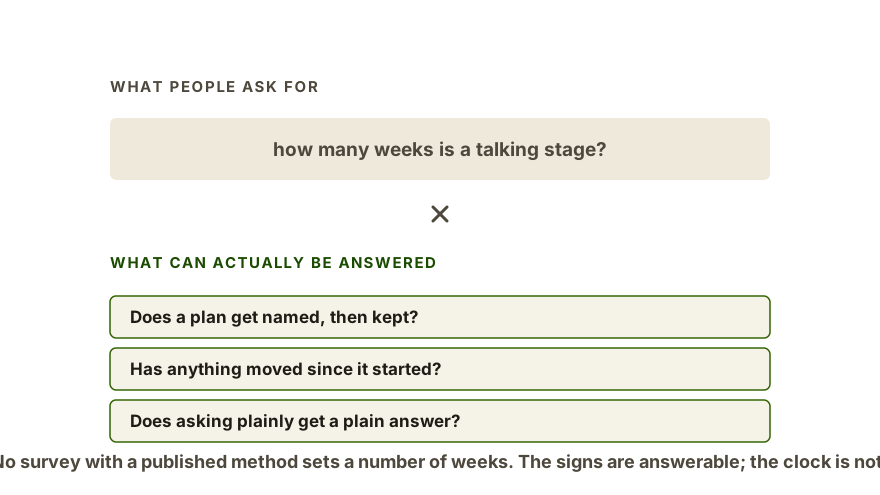
No. There is no measured average, median or recommended length for a talking stage, because no one with a published method has counted. The talking stage is a folk category — a phase people name after they are in it — and one person’s version is daily voice notes while another’s is an occasional drink. A number would need a definition of the phase that everyone answered against, and no such definition exists.
That absence is not a gap in this page. It is the finding. Anyone who gives you a week count is either repeating marketing or describing their own life.
Where do the week counts you have seen come from?
The week counts that circulate trace to two sources, mostly, and neither is measurement. One is a dating platform’s survey of its own subscribers, which describes people who pay that platform and no one else. The other traces to an annual survey commissioned by a dating company about its own market, quoted so often that the commissioning brand fell off the citation somewhere along the way.
Both are legitimate marketing. Neither is a probability sample of anyone, so neither supports a sentence beginning “on average”. We keep our numbers on a single page with sources attached — see /statistics/ — and there is no duration figure on it, deliberately.
What actually signals a talking stage is progressing?
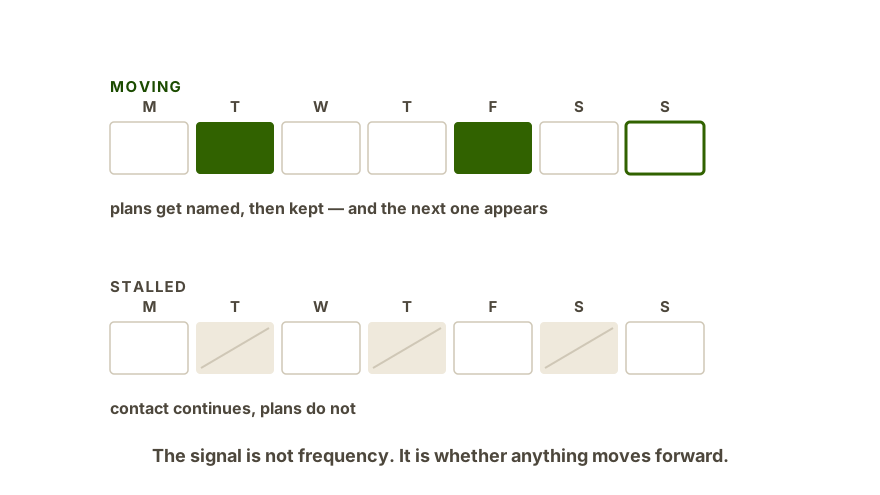
Direction, measured in information and access rather than in weeks. A talking stage is moving when each period gives you something you did not have before. That includes a plan made further ahead than the last one, a direct answer to a direct question, an introduction to someone in their life, or a stated preference about what they want. The content changes. That is the signal.
Text frequency is the signal people watch and the weakest one available. Daily messages that never turn into a plan describe a habit, not a direction. For example, a person who texts rarely and books the next Saturday is further along than a person who texts hourly and books nothing.
The other reliable marker is how a direct question lands. Asked what they are looking for, a person moving forward answers in a sentence you could repeat back to them. That does not mean the answer is one you want.
What signals a talking stage has stalled?
Repetition. A talking stage has stalled when the current stretch looks like the first: the same rhythm, the same class of plan, the same subjects that get changed. Consider a stretch where the same three topics get raised and dropped week after week — that repetition is the marker, not the calendar. Nothing has been learned about their intentions since the beginning, and asking produces a reply that is warm and contains no information.
A second marker is asymmetry of maintenance. If every plan, every reschedule and every check-in originates with you, the arrangement is not stalled by accident — it is being held at a level that suits one person. Describing that is not an accusation. Some people are content in the phase indefinitely and are not hiding it; the mismatch is in what each of you thinks is happening.
A third is the deflected define-the-relationship question. Once, plausibly bad timing. Again, the deflection is the answer.
| What you're watching | Moving forward | Stalled |
|---|---|---|
| Plans | Made further ahead each time; both of you propose them | Same-day, same format, always proposed by one of you |
| Direct questions | Answered in a sentence you could repeat back | Deflected, joked past, or answered without content |
| Their life | You keep learning new parts of it — friends, schedule, plans | You know roughly what you knew at the start |
| Your own read | You could say out loud what this is | You rehearse explanations for other people |
| Effort | Maintenance is shared and roughly reciprocal | It only continues while you carry it |
How long is too long in a talking stage?
The threshold is not a duration, it is a cost. A talking stage has gone on too long at the point where the ambiguity is costing you more than the information is worth. That happens when you are declining other options for something you cannot describe, or spending more time reading the situation than being in it. That point arrives at different times for different people, and for some it does not arrive at all.
There is a second, blunter version of the test. If you already know the answer you would give if they asked you to make it official, the phase has finished doing its job. Everything after that is waiting.
Why do two people run different clocks?
Because two people enter the same talking stage wanting different things, and both positions are ordinary. 26% of US adults who are not married, not living with a partner and not in a committed relationship say they are looking for either a committed relationship or casual dates (Pew Research Center, 2020) — openness to both, not a decision between them. The full question wording and base are on the statistics page.
The same split shows up in why people open the apps. 44% of US adults who had used a dating site or app in the past year said meeting a long-term partner was a major reason they used them (Pew Research Center, 2023; full breakdown). Another 40% of that same group said dating casually was a major reason (Pew Research Center, 2023; full breakdown). Respondents could name more than one reason, so these are not two opposing camps.
Read together, they explain the mismatch without assigning blame to anyone. Two people can be well into the same talking stage with entirely different pictures of what it is, and neither has broken a rule. The picture only aligns when someone says it out loud.

How do you move it forward — or end it?
You move a talking stage forward by asking, plainly, and by taking the answer as data rather than as a verdict on you. One sentence is enough: I’ve liked this, and I want to know what you’re looking for, because I’m looking for something with a label on it. No ultimatum, no rehearsed script, no strategic disappearing act. Those tactics do not appear on this site, because their aim is pressure and their yield is an answer you cannot trust.
Three replies are possible. A yes, which resolves it. A no, which resolves it. And a third answer that acknowledges the question without answering it — that one resolves it too, if you let it. An evasive reply repeated is a preference for the current arrangement.
Ending it can be short. You are not obliged to build a case, and a talking stage does not need a breakup speech. If you want the specific wording, our sibling page on questions to ask your talking stage covers the asking side, and the talking stage hub covers the phase end to end.
What if they go quiet instead of answering?
Ghosting means ending all contact suddenly, with no explanation — one way this phase can end, and Pew has measured the same instinct in stated intentions at the very start of dating. 52% of single US adults on the dating market say that after a first date they did not want to repeat, they would not contact the person but would let them know if the person contacted them (Pew Research Center, 2020; full breakdown). By contrast, 40% of the same group say they would contact the person and let them know (Pew Research Center, 2020; full breakdown). Those are stated intentions about a first date, not about ending an established connection, and Pew does not call either one ghosting — but if yours ended in a quiet exit, it is not personal to you.
Nor is the receiving end. About three-in-ten US adults (29%) say someone they had gone out with suddenly stopped answering their calls or messages without explanation (Pew Research Center, 2020) — a lifetime experience across all adults, not a yearly rate. The full question and base are on the statistics page. If that is where yours went, our page on talking stage red flags describes the pattern from both sides.
Is it still a talking stage, or is it a situationship now?
A talking stage is a phase with an expected exit. A situationship is a state that has stopped expecting one — Dictionary.com defines it as “a romantic or sexual relationship that its participants have not defined, and which can also lack commitment or exclusivity.” The practical difference is the direction of the question. In a talking stage, “what are we?” has not been asked yet. In a situationship, it has been asked or actively avoided, and the arrangement continued anyway.
That distinction changes what to do next, which is why it has its own page: talking stage vs situationship. Neither state is a failure, and one is not a downgrade of the other. They are different things to be in.
How long should a talking stage last before dating starts?
The phase ends when someone states an intention, not when a counter runs out. “Dating” in the sense people mean here — going out with a shared understanding that you are seeing each other — begins at the sentence, not at a milestone. Couples reach that sentence early and late, and the shorter version is not a rushed one.
What does change with time is the cost of not saying it. Early on, an unstated understanding is just early. Later, it becomes an arrangement both people have adapted to, and the same conversation gets heavier because there is now something to lose by having it. If you want the phase to end in dating rather than in drift, the useful move is having the conversation while it is still cheap.
Does a talking stage have to be exclusive, and do you date other people?
Neither is settled by default, and assuming otherwise is where the damage in this phase tends to start. A talking stage carries no built-in exclusivity: some people treat it as a single track, others keep seeing other people until a conversation says otherwise, and both understand themselves to be behaving normally. There is no shared rule to appeal to.
That makes it one of the few things worth raising early, and it is a smaller question than “what are we?”. Asking whether they are seeing other people is a question about facts rather than feelings, which makes it a narrower thing to answer. What you do with the answer is separate. Being told there are other people is information about the situation, not a ruling on your worth — and a person who answers it directly has told you something useful about how they handle harder questions later.
What this page does not do
We do not publish a number of weeks, and we do not publish tactics for making someone decide — going quiet on purpose, manufacturing competition, timed withdrawal. They work by pressure, and an answer produced under pressure tells you about the pressure.
We also stop at a clear line. If the uncertainty is producing anxiety that follows you into work and sleep, or thoughts about this person you cannot put down, the useful next step is a professional. They can talk about you, which an article about a dating phase cannot do. Naming what you are in is what this page can do. It is not the same as treating what it is doing to you.