
Questions to ask your talking stage
Questions to ask your talking stage are the ones that establish intent, availability and pace without asking anyone to sign anything. They are ordinary questions, asked out loud, at the point where guessing has stopped being useful.
In brief: there is no fixed script. The questions below are grouped by when they land, and the one that settles the most is also the easiest to keep postponing.
This page groups them by when they land. A question that works in the first week lands badly once there is a routine, and the question that settles the whole thing is the one easiest to postpone.
What counts as a talking-stage question?
A talking-stage question is a direct question about what this is or where it is going, asked before the relationship has a name. It differs from small talk in that the answer changes what you do next. For example, asking what someone’s typical week looks like only counts as a real question if a different answer would change your own plans. If you already know what you would do with either answer, it is a real question; if any answer leaves your behaviour identical, it is conversation.
Three things make the difference between a question and an interrogation: one at a time, asked in your own words, and asked when you are not upset. None of that is a technique. It is just the difference between wanting information and wanting a reaction.
| Stage | A question that fits | What it reveals |
|---|---|---|
| First couple of weeks | What does a normal week look like for you? | Availability and pace, before anyone needs to decide anything |
| Once there's a routine | What are you looking for right now? | Intent, stated plainly instead of guessed at |
| Before it gets serious | Are you seeing anyone else? / What would you call this? | Facts first, then whether they're ready to name it |
| If the answer is evasive | Ask once, clearly, and let a non-answer stand as one | Whether it's timing, disagreement, or a preference for staying undefined |
What should you ask in the first couple of weeks?
Early questions are about texture, not commitment. You are finding out how someone lives, and whether the version of them in your phone matches the version across a table. Nothing here requires a decision from either of you.
- What does a normal week look like for you? Availability shows up here before anyone discusses it. A person with three night shifts is not the same problem as a person who is free and slow to reply.
- What are you doing on the apps, or how do you usually meet people? Origin story, and it is genuinely informative — how something starts shapes the pace it keeps.
- What did you want out of last year? Softer than asking about the next five, and it surfaces the same material.
- How do you like to communicate — text, call, or mostly in person? A mismatch here gets read as disinterest for weeks by people who could have cleared it up in one sentence.
- What are you like when you are annoyed? Not a trap. It is a plain question, and a plain answer to it is useful.
What questions actually reveal what someone is looking for?
One question reveals what someone is looking for: what are you looking for right now? Asked plainly, with no preamble and no stated preferred answer. Every other version of that question is a variation on delaying the sentence.
Intent varies, and the same person can hold two aims at once. Pew Research Center found that 44% of US adults who had used a dating site or app in the past year said meeting a long-term partner was a major reason they used them (Pew Research Center, 2023). Among that same group of past-year users, 40% said dating casually was a major reason (Pew Research Center, 2023). Respondents could name more than one reason, so those are overlapping groups rather than two camps — which is precisely why the question has to be asked rather than inferred. Here’s an example of why that matters: two people can each be genuinely looking for a long-term partner and still disagree about whether this particular connection is that, which is a gap only the direct question closes. Full question wording and base: long-term → · casual →.
Two follow-ups do the rest of the work:
- Is that what you are looking for with me, or in general? It is easy to answer the general question when asked the specific one, without noticing you have done it.
- What would have to happen for that to change? This separates “not now” from “not this”.

What should you ask before it gets serious?
Once there are regular plans, sleepovers or a routine, the open questions change from what someone wants to what the two of you are doing. This is the point that is easiest to skip, and skipping it is the mechanism by which a talking stage becomes something else.
- Are you seeing anyone else? The question that goes unasked longest. Ask it as a question, not as an accusation.
- Do you want this to be exclusive? Distinct from asking whether they are seeing anyone else. One is about facts, the other about intent, and knowing one tells you little about the other.
- What would you call this if someone asked? The lowest-pressure version of the define-the- relationship conversation, because it asks about vocabulary rather than commitment.
- Do the people in your life know about me? Not a loyalty test. Whether someone is private in general or private about you specifically is a real difference, and you can ask which it is.
- What is your read on how this is going? Hands them the floor. What they choose to talk about is most of the answer.
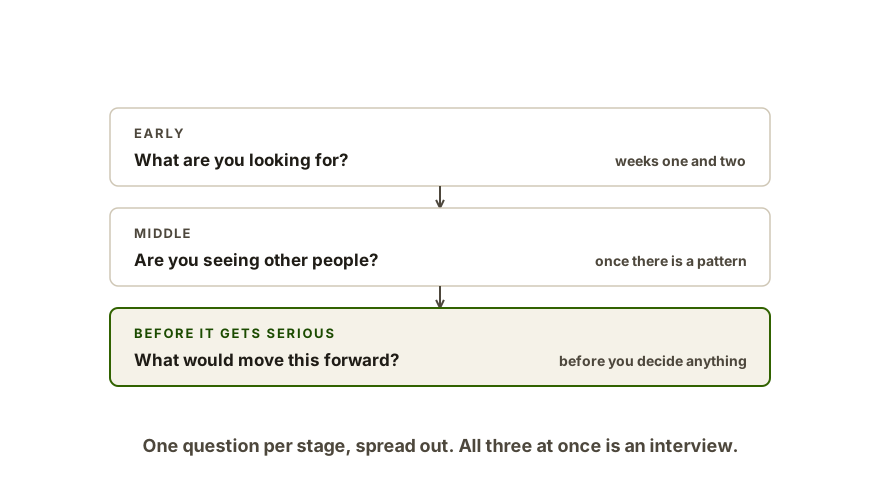
What are the deep questions worth asking?
Deep questions are not confessional questions. The useful ones ask how a person operates when something is at stake, and they are answerable by someone who has known you a short time. Consider asking what ended their last relationship, from their side of it — it needs no long history to answer honestly, only a willingness to.
- What ended your last relationship, from your side of it?
- Who do you call when something goes wrong, and how quickly?
- What did you learn about yourself in the last year that you did not enjoy learning?
- What does a good week look like for you, in detail?
- What do you want the next two years to contain — location, work, people?
- What do you do when you are hurt by someone you like?
Ask one. Let it be answered fully, answer it yourself, and leave the next one for another day. Running the whole list in one evening is not intimacy, it is a form.
Is the talking stage supposed to be flirty?
It can be, and flirty questions have a job: they signal interest without requiring a decision. What you noticed first, what a good date looks like, what someone was thinking at a particular moment — all of that establishes attraction while the practical questions stay unasked.
The failure mode is using them past their usefulness. Once the open question is intent, a flirty question answers a question nobody was asking, and the exchange can stay warm without moving. Warmth is not an answer about direction.
Are 100-question lists and compatibility tests worth using?
100-question lists and scored compatibility quizzes are not worth using, and the reason is mechanical rather than moral. A long list makes the asking feel productive while the one question that would settle things stays unasked, and a scored test converts a person into a result you can argue with.
There is also no measured basis for any of it: which questions predict which outcomes in early dating is not something anyone has established, so a numbered list is a format choice presented as a method. Ten questions you actually ask beat a hundred you screenshot.

What does an evasive answer mean?
An evasive answer is still an answer. There are three things it can mean: the person does not know yet, they know and expect you to dislike it, or they prefer the arrangement undefined. The three look identical in the moment and separate over the following weeks — someone who does not know yet may return to the subject on their own.
What it does not mean is that you asked wrong. Repeating the question in different words in the same conversation is a tempting next move; it asks the same thing twice rather than getting more. Ask once, clearly. Let it be answered or not answered, and treat a non-answer as information rather than as a round you lost.
If the arrangement stays undefined and continues anyway, it has a name and a very large company behind the survey that measured it. In a 2024 YouGov survey, 39% of US adults said they had ever been in a situationship (YouGov, 2024) — YouGov defined that as a romantic connection in a gray area, neither strictly platonic nor officially a committed relationship. That is ever, not currently; the statistics page carries the full question wording. That is the state described on talking stage vs situationship.
What if they go quiet after you ask?
Silence following a direct question is not a mystery. The person is deciding, or the answer is one they would rather not say, or they have opted out without saying so. You cannot tell which from the first two days of quiet, and messages sent to find out answer a different question than the one you asked.
Disappearing without explanation has been measured. About three-in-ten US adults (29%) say someone they had gone out with suddenly stopped answering their calls or messages without explanation (Pew Research Center, 2020) — all adults, over a lifetime, not per year. The full question and base are on the statistics page. Knowing that does not make it pleasant. It does mean the experience is not rare, and not evidence that you asked wrong.
Practically: send one message that names the situation without demanding a reply, then stop. If the arrangement had already become an undefined ongoing thing rather than an early talking stage, the wording is closer to what is on questions and texts for a situationship.
What do you do with the answers?
Three moves exist, and asking the question is what makes them available. You continue as you are, now knowingly. You name the thing, which in practice means saying what you want rather than requesting a label. Or you step back, because what they described is not what you are looking for and neither of you did anything wrong.
Timing questions belong to a different page: there is no correct number of weeks, only signs of progress and signs of a stall, which is the subject of how long a talking stage should last. Patterns worth noticing on both sides are catalogued in talking stage red flags, and the talking stage hub covers what the term means and where it came from.
Where this page stops
This page covers what to ask and how to read the answer. It does not cover what to do when the waiting itself has taken over — when checking a phone has reorganised your week, when sleep or appetite has changed, or when thoughts about one undefined arrangement crowd out everything else. That is not a question-phrasing problem, and no better-worded question fixes it.
If that is where you are, a therapist or your doctor is the right address, not a dating page. Asking better questions is a small tool. It is not a treatment for anxiety, and this site does not pretend otherwise.