
How to turn a situationship into a relationship is a question with one honest answer and a lot of folklore around it. The honest answer is that the arrangement changes status when it gets named and both people accept the name. Dictionary.com defines a situationship as “a romantic or sexual relationship that its participants have not defined, and which can also lack commitment or exclusivity” — so by definition, the missing piece is the definition itself, not the feeling and not the time invested.
What actually turns a situationship into a relationship?
A conversation is what turns a situationship into a relationship: one person states what they want the arrangement to be, and the other person agrees. That is the whole mechanism.
In brief: nothing converts a situationship into a relationship except a named exchange both people agree to — not more time, not more closeness, and not waiting for it to become obvious.
It can happen in one short exchange, in a kitchen, with no preparation. What it cannot do is happen by accumulation: more time, another shared weekend, another set of keys left on a table. Those things deepen the behaviour, and behaviour is what people mistake for status. Two people can share a bed, a routine, and a favourite restaurant and remain undefined, because nobody has ever said the sentence. It is the same gap Dictionary.com points at in defining a situationship as a connection its participants “have not defined” (Dictionary.com).
This is also why the question sits differently from the way it is usually asked. People arrive looking for a way to make someone want a relationship. There is no such method, and anything sold as one is a way of not asking. What exists is a way to find out — quickly, without theatre — which is worth more than a strategy, because it returns an answer you can act on now rather than eventually.
When is it too early to ask?
There is no correct week to ask. Nobody has measured how long an undefined arrangement runs before it resolves, so any timeline offered to you is invented. The useful test is not the calendar but whether the answer would change what you do. Consider whether you have started declining other options, holding your weekends open, or feeling the ambiguity in the middle of your working day — if so, the question has already become practical, and asking it early costs less than sitting in it.
The one thing worth checking before you ask is what you actually want to hear. Going in without a position turns the conversation into an audition where the other person sets the terms. Going in with a sentence — “I want this to be a relationship” — makes the exchange symmetrical. Both people get to say what they want, and both get an answer.
How do you ask without a script?
Say your part first, then ask theirs. “I like this and I want it to be a relationship. Do you want that?” Nothing before it, nothing softening it into deniability. The order matters: leading with your own position means you are not asking someone to guess your intent, and it removes the option of answering with a question.
A few practical conditions make the answer clearer. In person rather than by message, because tone carries information that text drops. Not immediately after sex and not at the end of a night out, when both of you are running on the mood of the evening. Not as an ultimatum, since a label agreed under pressure is a label that does not hold. And once you have asked, stop talking. The silence after the question belongs to the other person, and filling it is one reliable way to talk yourself out of a real answer.
If you want more wording to work from, the sibling page on what to text and what to ask collects the phrasings for clarity rather than for pressure.
What does an evasive answer mean?
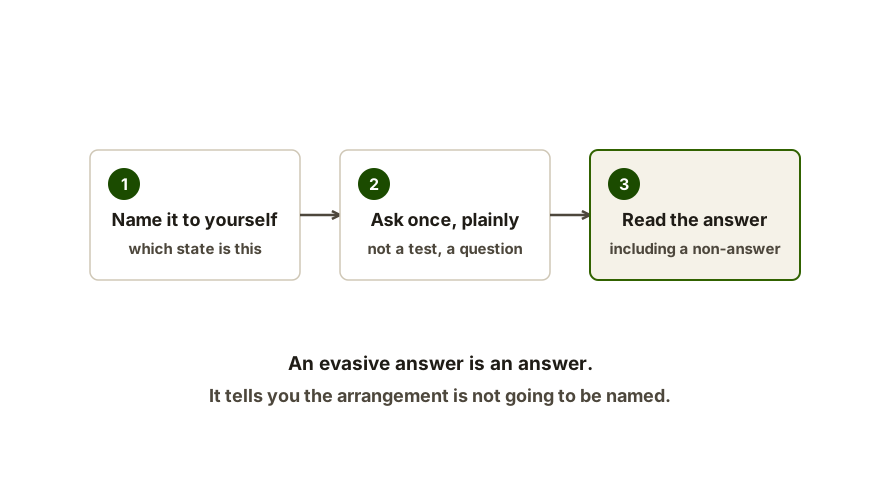
An evasive answer means no label is being offered today. That is information, and it is enough to act on. An evasive answer is often read as a puzzle to be solved with more patience, when it is closer to a plain statement: this person is not willing to attach a word to the arrangement right now. Whether that is about you, about their circumstances, or about nothing at all is unknowable from the outside — and trying to work it out is how time disappears.
| What you hear | What it tells you | What it does not tell you |
|---|---|---|
| "Yes, I want that too" | A label now exists and is agreed. The arrangement is defined | Nothing further is required — the status question is closed |
| "I don't want to put a label on it" | No label is on offer. The arrangement stays undefined | Whether the person would ever want one, or why |
| "I'm not ready for a relationship right now" | Accurate about today; the status stays as it is | Whether 'right now' has an end. Do not fill it in for them |
| "Why do we need to define it?" | The subject is being redirected rather than answered | That the answer is no. It means you still do not have one |
| "I like where this is going" | Warmth, and no status change. Feeling was answered, not the question | Anything about exclusivity or intent — those were not addressed |
| A change of subject, or no answer at all | The question is not going to be answered in this conversation | That asking again later is pointless, or that it will land differently |
The table exists to stop one specific loop: hearing a non-answer, deciding it was almost a yes, and starting the clock again. A non-answer leaves you exactly where you were, holding the same undefined arrangement, with one extra fact — that it was asked about and not resolved. What you do with that fact is a separate decision, and ending it is only one of the options.
Can a situationship become a relationship without a conversation?
A situationship can drift into relationship behaviour without a conversation and still be undefined on paper, which is the version people find most confusing. Imagine two people who gradually behave like a couple while other people treat them as one, and neither has ever said a status word. What is missing in that case is not affection or commitment in the everyday sense; it is a shared answer both would give independently if asked separately.
That gap is worth closing precisely because it feels unnecessary. An arrangement that has never been stated has never been agreed, which means each person is operating on a private assumption about exclusivity, about the future, about what a bad month would mean. Those assumptions surface only when they are tested, and being tested is rarely convenient. One sentence now costs less than finding out later that the two of you were holding different definitions of the same arrangement.
What if the answer is no, or “not yet”?
If the answer is no or “not yet”, you have three moves, and none of them is the mature one. You can stay, deciding in advance what you will and will not do inside an arrangement that carries no promises; the page on limits rather than rules is about exactly that decision. You can ask again later, once, with a real interval in between rather than a weekly re-check. Or you can end it, which is a genuine ending even though nothing was ever officially begun.
What does not work is treating “not yet” as a project. Waiting for someone to arrive at a different answer is a plan with no completion condition, and no way to tell how long you are signing up for. The one thing an answer of “no” does give you is a date on the calendar: from here, whatever you choose, you are choosing with the information rather than around it.

What are the signs a situationship is turning into a relationship?
The signs that a situationship is turning into a relationship are movement, not proof. The only proof is the agreed word.
- They raise the status question themselves. Somebody other than you says “what are we”, or volunteers where they stand. This is the sign that matters most, because it is the mechanism itself starting.
- The planning horizon lengthens. Plans get made well ahead, on the assumption that you will both still be there. Plans that only ever get made at short notice tell you less.
- You are introduced without hedging. Not a name with no relation attached, but a description the other people in the room recognise.
- Other people are addressed directly. The subject of dating anyone else gets discussed rather than avoided — in either direction.
- The connection extends past the two of you. Their friends, their sister, their group chat. An undefined arrangement can stay sealed off from the rest of a life.
- Routine questions start assuming a future. Where are we spending the holiday, whose car do we take, what are we doing in August.
None of these is a status change. They describe an arrangement that has room for one, which is different. Several of these appearing at once is a good reason to ask, not a reason to stop needing to. If you are not yet sure which state you are in, the sibling page on whether you are in a situationship sorts that first.

How often do situationships become relationships?
Nobody knows, and the absence is worth stating plainly rather than filling. No probability-sample survey has tracked what share of undefined arrangements end up defined, so every percentage in circulation on this question is either invented or borrowed from a dating company surveying its own users. This site publishes a number only when a real source exists, and here none does.
What is measured is how common the arrangement is. YouGov found in 2024 that 39% of US adults (YouGov, 2024) say they have ever been in a situationship — ever, not right now — asked about a romantic connection that exists in a gray area, neither strictly platonic nor officially a committed relationship. The method behind that figure is on the statistics page. Being in one is ordinary; what happens next has simply never been counted.
Something else that is measured helps explain how one of these conversations can end in a mismatch. Pew Research Center reported in 2023 that 44% of US adults (Pew Research Center, 2023) who had used a dating site or app in the past year said meeting a long-term partner was a major reason they used them. In the same survey, 40% of that group (Pew Research Center, 2023) said dating casually was a major reason. Respondents could give more than one reason, so those groups overlap rather than compete. Pew also found that 9% of US adults (Pew Research Center, 2023) had used a dating site or app in the past year, so this describes a slice of the public rather than everyone. The takeaway is not a verdict about anybody’s motives: it is that two people in the same connection can hold two different destinations for it, both perfectly ordinary, and that neither destination announces itself without being said.
What is a serious situationship?
A serious situationship is the phrase people reach for when the depth of a connection and its status have come apart: a shared history, real intimacy, a place in each other’s weeks, and still no agreed word for it. The seriousness is not imaginary. It lives in behaviour, which is why the arrangement can feel heavier than some defined relationships and still not be one.
The practical consequence is that seriousness does not convert into status on its own. A serious situationship changes category by the same route as any other: Dictionary.com’s test — has it been defined — is satisfied only when someone names it. If you want the line drawn on paper, the comparison page on a situationship versus a relationship sets out the axes side by side.
What this page will not tell you to do
Not disappearing for a week to prompt a reaction. Not seeing other people visibly so it gets noticed. Not withdrawing warmth on a schedule. These circulate as advice for this exact query, and they share one structure: producing a response by manipulating conditions rather than asking a question. Even when they appear to work, what they produce is a label agreed under pressure, which is the least durable version of the thing you wanted.
There is also a boundary this page cannot cross. If the ambiguity has stopped being a dating problem — if it is interrupting your sleep, your work, or your ability to think about anything else — that is outside what an article about vocabulary can help with, and it is worth taking to a doctor or a licensed therapist rather than to another explainer. Nothing here is a diagnosis and nothing here is treatment.
For the rest of the map — what the word means, what the alternatives are, and which decisions exist — start from what a situationship is.